
The simplest difference is this: Flores de Mayo is the month-long May devotion; Santacruzan is the procession and pageant that usually ends it.
In Filipino communities, the two are closely connected, so people often use the terms interchangeably. But they are not exactly the same. Flores de Mayo centers on May flower offerings and devotion to the Virgin Mary. Santacruzan centers on the Holy Cross and the story of Saint Helena, represented in the Philippines by Reyna Elena.
If you want the full standalone guides, read Flores de Mayo in the Philippines and Santacruzan Philippines. For broader Philippine seasonal traditions, see our Holy Week Philippines guide and Philippine Independence Day guide. This page is the quick comparison for anyone asking, "Ano ba talaga ang pinagkaiba?"
Quick comparison: Santacruzan vs Flores de Mayo
| Question | Flores de Mayo | Santacruzan |
|---|---|---|
| What is it? | Month-long Marian devotion | Procession/pageant and religious parade |
| Main focus | Virgin Mary, flower offerings, prayers | Holy Cross, Saint Helena, Reyna Elena |
| Usual timing | All of May, May 1 to May 31 | Near the end of May, often final week or last Sunday |
| Common participants | Children, families, catechists, parish groups | Sagalas, escorts, angels, sponsors, parish/community members |
| Main activity | Offering flowers, praying, singing, catechism, community snacks | Procession through the streets with symbolic queens and floral arches |
| Mood | Devotional, parish-based, often daily or weekly | Grand, public, ceremonial, pageant-like |
| Easy memory aid | The month | The finale |
The cleanest way to explain it to a child or foreign visitor is: Flores de Mayo is the whole May tradition; Santacruzan is the big procession people remember most.
What is Flores de Mayo?
Flores de Mayo literally means "Flowers of May." In the Philippines, it refers to a Catholic May devotion in honor of the Virgin Mary. Communities offer flowers, pray the Rosary, sing Marian hymns, teach children, and gather around the parish church or barangay chapel.
It is usually not a one-day event. In many places, Flores de Mayo happens throughout May. Some parishes hold daily flower offerings. Others hold weekend activities, catechism, or a shorter local version depending on volunteers, schedule, budget, and community size.
The heart of Flores de Mayo is devotional. Children often bring flowers. Adults organize prayers. Parish workers or catechists guide the activities. After the prayers, some communities serve simple merienda for children. The tradition feels both religious and neighborhood-based.
It is also a way Filipino Catholic families introduce children to church life. A child may not fully understand Marian theology, but they understand flowers, candles, singing, lining up, and being part of something with other kids.
For the longer history, including Fr. Mariano Sevilla and the spread of the practice, use the full Flores de Mayo guide.
What is Santacruzan?
Santacruzan comes from Santa Cruz, meaning Holy Cross. It is a religious procession and pageant that commemorates the search for the True Cross by Saint Helena, mother of Emperor Constantine. In the Filipino procession, Saint Helena is represented by Reyna Elena, usually the most honored sagala.
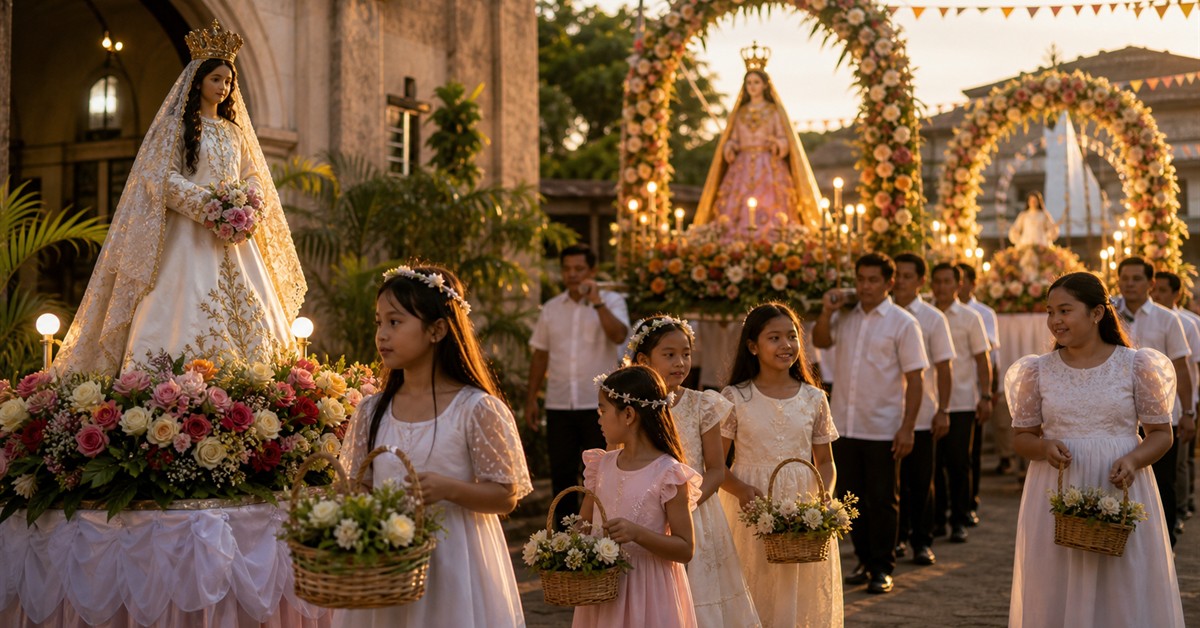
The Santacruzan is the part people photograph: gowns, floral arches, candles, banners, escorts, angels, brass bands, and a route through the streets. But it is not supposed to be just a beauty parade. Its religious narrative is the Holy Cross and Saint Helena's search.
The procession includes sagalas, or women and girls representing biblical, historical, Marian, and allegorical figures. Some roles vary by town, but the most recognized one is Reyna Elena, often accompanied by a young boy representing Constantine.
In some communities the Santacruzan is modest and prayerful. In others it becomes elaborate, fashion-forward, social, and almost pageant-like. Both versions can still be part of the same living tradition, though church leaders sometimes remind communities not to let glamour erase the religious meaning.
For a role-by-role guide, see Santacruzan Philippines: History, Sagala Roles, and What to Expect.
Why people confuse the two
People confuse Santacruzan and Flores de Mayo for practical reasons.
First, they happen in the same season. If a child participates in May flower offerings and then joins a procession at the end of the month, the family may remember all of it simply as "Flores" or "Santacruzan."
Second, the same people often organize both. The parish, barangay chapel, youth groups, sponsors, choir, catechists, parents, and volunteers may all be involved in both the daily May devotion and the final procession.
Third, Santacruzan is more visible. A nightly prayer service is meaningful but quiet. A procession with gowns, lights, flower arches, and crowds is easier to remember. Because of that, many people use the most visual part to refer to the whole season.
Finally, Filipino usage is flexible. In casual speech, people may say "Flores" when they mean the whole May celebration, "Santacruzan" when they mean the procession, or either term when referring to the community event. That is normal conversation, but for explaining the tradition clearly, the distinction matters.
Timing: when each one happens
Flores de Mayo is tied to the month of May. It usually runs from May 1 to May 31, though the actual schedule depends on the parish or community.
Santacruzan is usually held near the end of the Flores de Mayo season. Common schedules include:
- the final week of May
- the last Sunday of May
- the last day of May
- a date chosen by the parish or barangay based on volunteers, route permits, weather, or sponsorship
Neither Flores de Mayo nor Santacruzan is a Philippine regular public holiday. These are religious and cultural observances organized locally, not national days off.
Because the Philippines is already entering the rainy-season transition around late May and early June, some communities schedule carefully around weather. In larger towns, organizers may also coordinate traffic, security, lighting, sound systems, and procession routes.
Religious meaning: Mary vs the Holy Cross
One useful way to remember the difference is by focus.
Flores de Mayo is Marian. It honors the Virgin Mary through flowers, prayers, songs, and devotion. The flower offering is central to its name and practice.
Santacruzan is centered on the Holy Cross. It reenacts or commemorates the search for the True Cross by Saint Helena. Reyna Elena's cross is not just a prop; it points to the story at the center of the procession.
This is why the two traditions can fit together without being identical. Marian devotion fills the month. The Holy Cross narrative becomes the ceremonial finale.
Who participates?
Flores de Mayo often centers children. Kids bring flowers, line up, sing, pray, learn catechism, and receive snacks or small tokens depending on the parish. Parents, grandparents, parish workers, catechists, and local volunteers help organize the schedule.
Santacruzan has a more formal cast. There are sagalas, escorts, angels, flower bearers, arch bearers, musicians, sponsors, and organizers. Families may sponsor a role, gown, floral arch, or part of the route. In some towns, participation becomes a major social honor.
That difference explains the different feel. Flores de Mayo can feel like a neighborhood devotion. Santacruzan can feel like a public performance of faith, beauty, community status, and local identity.
Why Santacruzan became so visually grand
Santacruzan endures partly because it is designed to be seen. A procession moving through the street turns religious memory into a shared public event. Families come out to watch. Children remember the flowers and gowns. Sponsors invest in the roles. Photographers capture the evening.
Over time, many communities developed a strong pageant element: terno gowns, dramatic lighting, professional styling, choreographed entrances, and prominent local personalities. This can make outsiders think Santacruzan is mainly a beauty event.
That is incomplete. The pageantry is real, but the religious story is still there: Reyna Elena and the cross. The best Santacruzan celebrations hold both together: beauty and meaning, spectacle and prayer.
Common mistakes to avoid
Do not say Flores de Mayo is "just a parade." It is a month-long devotion, and in many parishes the daily or weekly flower offerings are the real core.
Do not say Santacruzan is "just Flores de Mayo." It is connected to Flores de Mayo, but it has its own focus, roles, and story.
Do not reduce Santacruzan to gowns only. The gowns are visible, but the tradition points to Reyna Elena, Saint Helena, and the Holy Cross.
Do not assume every town does it the same way. Some celebrations are simple. Others are grand. Some are deeply parish-led. Others include heavier social or pageant elements.
Do not assume the schedule is identical everywhere. Ask the parish or barangay for local dates, especially if you plan to attend, sponsor, photograph, or participate.
How to explain the difference depending on who asks
If a child asks, keep it concrete: Flores de Mayo is when people offer flowers to Mama Mary during May. Santacruzan is the big procession near the end with Reyna Elena and the cross.
If a student asks, add the structure: Flores de Mayo is the broader religious observance, while Santacruzan is a specific ritual performance within that season. The first is Marian and month-long; the second is tied to the Holy Cross and Saint Helena.
If a tourist asks, start with what they will see: Flores de Mayo may look like parish flower offerings, prayers, children, hymns, and simple community gatherings. Santacruzan is the more public event with gowns, floral arches, escorts, candles, music, and a street route.
If a parish volunteer asks, the distinction is practical: Flores de Mayo needs a schedule for daily or weekly devotions, flower offerings, catechism, choir, and children. Santacruzan needs a route, permits, sagala assignments, sponsors, security, lighting, sound, gowns, arches, and crowd management.
If someone says, "Pareho lang naman," you can answer kindly: in everyday speech, people may blend the terms, but if we are explaining the tradition accurately, Flores de Mayo is the whole May devotion and Santacruzan is the culminating procession.
That distinction is useful because it protects both meanings. Flores de Mayo is not reduced to spectacle, and Santacruzan is not reduced to gowns. One teaches devotion through flowers and prayer; the other dramatizes a story of the cross through procession and symbols.
Source note
This comparison follows the distinction used in Filipino cultural and Catholic descriptions of the May devotion and the procession. Catholics & Cultures describes Flores de Mayo and Santacruzan as linked Philippine Catholic May practices, while current reporting around the 2026 season, including GMA News coverage of Cardinal Pablo Virgilio David's reminder, emphasizes that Santacruzan is more than pageantry and should retain its religious meaning.
For site-specific context, this page also builds on our existing Flores de Mayo and Santacruzan explainers.
Frequently asked questions
Are Santacruzan and Flores de Mayo the same?
No. Flores de Mayo is the month-long May devotion to the Virgin Mary. Santacruzan is the religious procession and pageant usually held near the end of May as the culmination of the season.
Which comes first, Flores de Mayo or Santacruzan?
Flores de Mayo comes first because it spans May. Santacruzan usually happens near the end of May, often in the final week, on the last Sunday, or on a date set by the parish or community.
What does Santacruzan commemorate?
Santacruzan commemorates the search for and finding of the True Cross by Saint Helena, represented in the Filipino procession by Reyna Elena.
What does Flores de Mayo mean?
Flores de Mayo means "Flowers of May." In the Philippines, it refers to the May devotion to the Virgin Mary, marked by flower offerings, prayers, hymns, catechism, and community participation.
Why do Filipinos confuse Santacruzan and Flores de Mayo?
They are confused because they happen in the same month, are often organized by the same parish or community, and the Santacruzan is the most visible part of the Flores de Mayo season.
Is Santacruzan only a beauty pageant?
No. Santacruzan can look pageant-like because of gowns, arches, and public presentation, but its religious meaning is the Holy Cross and the story of Saint Helena. The pageantry is the visual form; the religious story is the core.
Final answer
If you remember only one line, remember this:
Flores de Mayo is the May devotion; Santacruzan is the procession that usually crowns it.
They belong together in Filipino Catholic culture, but they are not the same thing.