
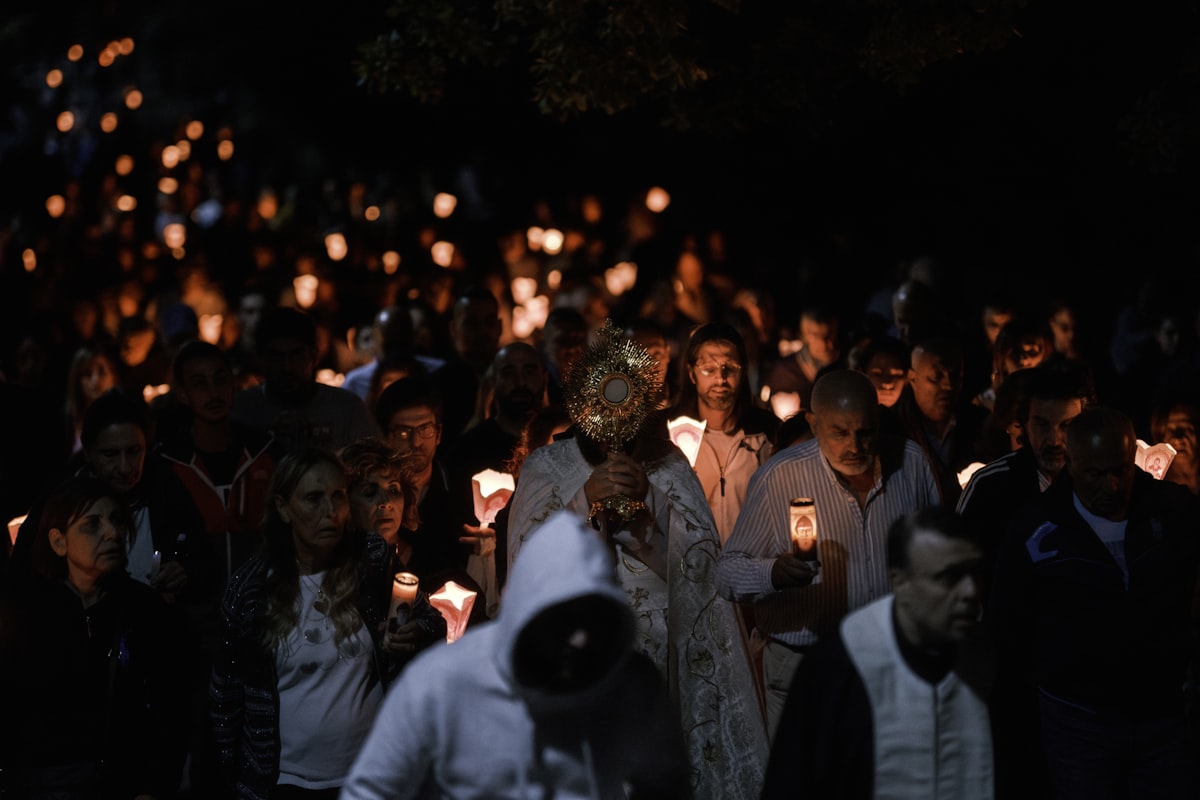
Every May in the Philippines, barangays and parishes across the country end their month-long Flores de Mayo devotion with a procession unlike anything else in Filipino religious life. Young women in formal Filipiniana gowns walk beneath arches of flowers. A brass band plays. Children dressed as angels carry banners. At the center of it all, a woman in the most elaborate gown of the evening plays Reyna Elena — Saint Helena — holding a cross and walking as the most honored figure in a tradition that stretches back over a century.
This is the Santacruzan, and while many Filipinos have witnessed or participated in one, the full meaning of the tradition — where it comes from, what the characters represent, and why communities continue to stage it each May — is less commonly known.
This article covers the complete picture: the historical legend, the organizational structure, every major sagala role and its symbol, and what makes the Santacruzan distinctly Filipino. If you want the broader month-long context first, see Flores de Mayo in the Philippines: Meaning, History, and Traditions.
What does Santacruzan mean?
Santacruzan comes from the Spanish Santa Cruz, meaning Holy Cross. The full name signals the tradition's core story: it commemorates the search for and discovery of the True Cross — the cross on which Jesus Christ was crucified.
In everyday Filipino speech, the word Santacruzan refers both to the procession itself and to the specific annual celebration at the close of Flores de Mayo. It is not the same as a simple religious procession (prusisyon) — the Santacruzan is a full pageant with assigned roles, symbolic costumes, and a specific narrative it enacts each year.
Santacruzan vs. Flores de Mayo: What is the difference?
These two terms are often used interchangeably, but they refer to different things:
| Flores de Mayo | Santacruzan | |
|---|---|---|
| Duration | All of May (30 days) | A single event, usually late May |
| Focus | Daily devotion to the Virgin Mary | The Holy Cross and Saint Helena's search |
| Form | Daily prayers, flower offerings, hymns | Religious procession and pageant |
| Scale | Intimate, community-level | Public, often elaborate |
| Characters | None | Sagalas representing biblical and historical figures |
The simplest way to remember it: Flores de Mayo is the month; Santacruzan is the finale.
The legend behind the Santacruzan: Saint Helena and the True Cross
The Santacruzan commemorates an event from the 4th century CE. Saint Helena (Santa Elena in Spanish), mother of the Roman Emperor Constantine the Great, is said to have made a pilgrimage to Jerusalem in approximately 326-328 CE to find the True Cross.
According to the tradition preserved in both Western and Eastern Christianity, Helena located three crosses at a site believed to be the site of the Crucifixion. To determine which was the True Cross, a sick or recently deceased woman (accounts vary) was touched to each cross in turn. When she recovered or was revived upon contact with the third cross, that one was identified as the True Cross.
Helena brought parts of the cross back to Rome and to Constantinople, and she was later canonized as a saint. In the Philippines, she is called Reyna Elena — Queen Helena — and her role as the finder of the Holy Cross became the anchor of the Santacruzan tradition.
Constantine her son is typically represented in the procession by a young boy who walks beside the Reyna Elena sagala.
How the Santacruzan is organized
The hermano/hermana mayor
Every Santacruzan has a lead organizer called the hermano (male) or hermana (female) mayor — the principal sponsor of the entire celebration. This is a position of honor and significant responsibility. The hermano/hermana mayor coordinates the preparation, secures the venue and route, manages the roster of sagalas, and often bears a substantial portion of the financial cost.
Being chosen as hermano or hermana mayor is a distinction that many families take seriously. In smaller communities, the role rotates among respected families; in larger towns, it may be competed for or auctioned to raise funds for the parish.
Sponsors and participation
Beyond the lead sponsor, individual sagala roles are often sponsored by families or community members who underwrite the cost of gowns, arches, and other production elements for a particular queen. This makes the Santacruzan a community investment — many households contribute to the collective spectacle.
Preparation
Preparation for a typical Santacruzan involves weeks of:
- Casting the sagalas from community members (young women, girls, and increasingly, LGBTQ+ participants in some communities)
- Gown design and fitting — Filipiniana formal wear, terno, or Maria Clara-style gowns, often custom-made
- Floral arch construction — arches of fresh or artificial flowers are built for each sagala's canopy
- Rehearsals — sagalas practice their walk, posture, and positioning in the procession order
- Route coordination with the barangay and church
The sagalas: roles, symbols, and meaning
The heart of the Santacruzan is the sagalas — the women and girls chosen to personify specific figures. Each sagala walks under a floral arch, carries a specific symbolic object, and occupies a defined place in the procession. The most prestigious roles come toward the end of the procession, with Reyna Elena as the grand finale.
The exact number and roster of sagalas varies by community, but the following are the most commonly included roles:
The principal sagalas
| Title | Represents | Symbol/Attribute |
|---|---|---|
| Reyna Elena | Saint Helena, finder of the True Cross | Large cross; accompanied by boy as Constantine |
| Reyna Emperatriz | Imperial majesty; Constantine's dynasty | Scepter and orb |
| Reyna Banderada | Queen bearing the flag; patriotism | Philippine flag or banner |
| Reyna de las Flores | Queen of Flowers | Bouquet of flowers or flower crown |
| Reyna de las Estrellas | Queen of the Stars | Crown of stars or a starry veil |
| Reyna Sheba | Biblical Queen of Sheba | Jewels; often depicted as darker-skinned |
| Reyna Abogada | The Advocate | Legal scroll or document |
| Reyna Sentenciada | The Condemned | Chains; represents those awaiting judgment |
| Reyna Mora | Queen of the Moors; religious diversity | Crescent moon and star |
| Reyna Justicia | Queen of Justice | Scale and sword |
| Reyna Fe | Queen of Faith | Cross |
| Reyna Esperanza | Queen of Hope | Anchor |
| Reyna Caridad | Queen of Charity | Heart |
The three theological virtues
Reyna Fe (Faith), Reyna Esperanza (Hope), and Reyna Caridad (Charity) represent the three theological virtues of Catholic teaching, drawn from 1 Corinthians 13. Their inclusion in the Santacruzan gives the procession a catechetical dimension — they are not just decorative roles but teachings made visible.
Angels and minor participants
Younger children — girls especially — often participate as angels, dressed in white with wings. They may carry Marian titles written on ribbons, or lead the procession while scattering flowers. This gives even the youngest community members an active, visible role in the celebration.
The procession itself
The Santacruzan procession typically unfolds over one to two hours and follows a route through the streets of the town or barangay before returning to the church. Here is how it generally works:
- Opening prayers and blessing at the church or chapel
- The procession begins — participants form a line and move through the designated route
- Order of sagalas — the procession moves from the least prominent roles (angels, minor queens) toward the most honored ones, building to the climax of Reyna Elena
- Music throughout — a brass band or recorded music accompanies the walk; hymns, solemn marches, and occasionally popular religious songs
- Spectators line the route — community members and families watch from the sidewalks; some join in as the procession passes
- Return to church — the procession ends where it began, with a closing Mass or prayer service
In major towns, particularly in Bulacan, Pampanga, and Metro Manila, the Santacruzan can be a large-scale event with dozens of sagalas, elaborate floats, professional lighting, and hundreds of participants and spectators. In smaller communities, the same structure plays out at a more intimate scale.
What to wear: spectators vs. participants
As a spectator, there is no dress code. Smart casual or modest Sunday attire is appropriate — you will be watching from the street or the church courtyard.
As a sagala, attire is specific to the role:
- Formal Filipiniana — terno, Maria Clara, or formal evening gown in Philippine style
- Accessories, crown, or sash appropriate to the character
- All arranged by the sponsor or the sagala's family in coordination with the organizer
As an escort (the young man walking alongside a sagala), the standard attire is a barong Tagalog or formal suit.
Santacruzan in the Filipino diaspora
One of the signs of the Santacruzan's deep cultural roots is that it travels with Filipino communities abroad. Filipino parishes and community organizations in the United States, Canada, Australia, and across Europe hold their own Santacruzan celebrations each May — sometimes in church halls, community centers, or outdoor venues.
These diaspora celebrations serve an additional function: they are a way for second-generation Filipinos and those who have never been to the Philippines to experience and connect with a tradition that might otherwise remain only in family stories. The Santacruzan abroad often preserves the ceremony more deliberately than in the Philippines, precisely because it carries that added weight of cultural transmission.
How the tradition has evolved
The Santacruzan as practiced today is not identical to what it was in the 19th century. A few notable changes and adaptations:
- LGBTQ+ inclusion: In many communities, particularly in more urban and progressive areas, gay men and transgender women have long been included as sagalas. This is not a recent development — Filipino trans women (bakla culture) have participated in Santacruzan for decades. In some towns, this is mainstream and unremarkable; in others, it remains contested.
- Pageant-like production: Especially in larger towns, the Santacruzan has taken on elements of beauty and fashion pageantry — elaborate gowns, professional styling, runway walks. This sometimes draws criticism as commercialization, and sometimes is embraced as an expression of Filipino aesthetics.
- Advocacy themes: Some contemporary Santacruzan celebrations incorporate advocacy messaging — environmental themes for floral arches, or roles dedicated to community heroes.
These adaptations reflect the tradition's vitality. A tradition that cannot evolve tends to become a museum piece; the Santacruzan, for all its changes, remains a living practice.
Why the Santacruzan endures
Several things combine to keep the Santacruzan going across generations and across geographies:
Community investment — the logistical weight of organizing a Santacruzan distributes across dozens of families and individuals. When many people contribute, many people have a stake in the outcome.
The pageant element — the visual spectacle of elaborately gowned women walking through the street is memorable in a way that a simple prayer service is not. The Santacruzan is designed to be seen.
Children's participation — by giving young children roles as angels and giving older youth roles as sagalas or escorts, the tradition actively recruits the next generation of participants.
Flexibility — the tradition has absorbed changes in fashion, in community composition, and in social values without losing its recognizable core. It is not fragile in the way that more rigidly defined traditions can be.
The legend at the center — the story of a queen who journeys to find the cross on which her Savior died is, in its way, a compelling narrative. The Santacruzan gives that story a local, communal expression every year.
Frequently asked questions
What is the Santacruzan in the Philippines?
Santacruzan is a religious procession and pageant held at the end of Flores de Mayo, the month-long Catholic May devotion. It reenacts the legend of Saint Helena (Reyna Elena) searching for the True Cross. Women and girls are assigned roles as sagalas — symbolic queens representing biblical, historical, and allegorical figures — and walk in procession through the community.
What does Santacruzan mean in Filipino?
Santacruzan comes from the Spanish Santa Cruz, meaning Holy Cross. The word refers both to the tradition itself and to the procession event held at the close of Flores de Mayo.
Who is Reyna Elena in Santacruzan?
Reyna Elena represents Saint Helena, mother of the Roman Emperor Constantine the Great, who according to Catholic tradition discovered the True Cross in Jerusalem in the 4th century. She is the most honored sagala role in the Santacruzan procession and typically walks last or near last, accompanied by a young boy representing Constantine.
How many sagalas are there in a Santacruzan?
The number varies by community. Small barangay celebrations may have 10-15 sagalas. Large town celebrations can feature 30 or more. The core roles — Reyna Elena, the three theological virtues (Fe, Esperanza, Caridad), and a few others — are nearly always included.
Is Santacruzan only for women?
Historically it has been primarily women and girls in the sagala roles, but many Filipino communities have long included gay men and transgender women as sagalas. This varies by location and community.
When is the Santacruzan held?
Santacruzan is usually held on the last Sunday or last day of May, at the close of the Flores de Mayo observance. Some communities hold it in the final week of May; others hold smaller santacruzans on specific feast days within the month.
Is Santacruzan a public holiday?
No. Santacruzan is a religious and cultural observance, not a Philippine public holiday. It is organized by parishes and barangays rather than by the government.
How is the Santacruzan different from a regular Filipino procession?
An ordinary prusisyon (procession) typically involves carrying a religious image through the streets for a feast day. The Santacruzan is a full pageant with assigned characters, symbolic costumes, an organizational structure (hermano/hermana mayor), and a specific narrative: the legend of Reyna Elena and the Holy Cross. It is more theatrical and more community-produced than a standard procession.