
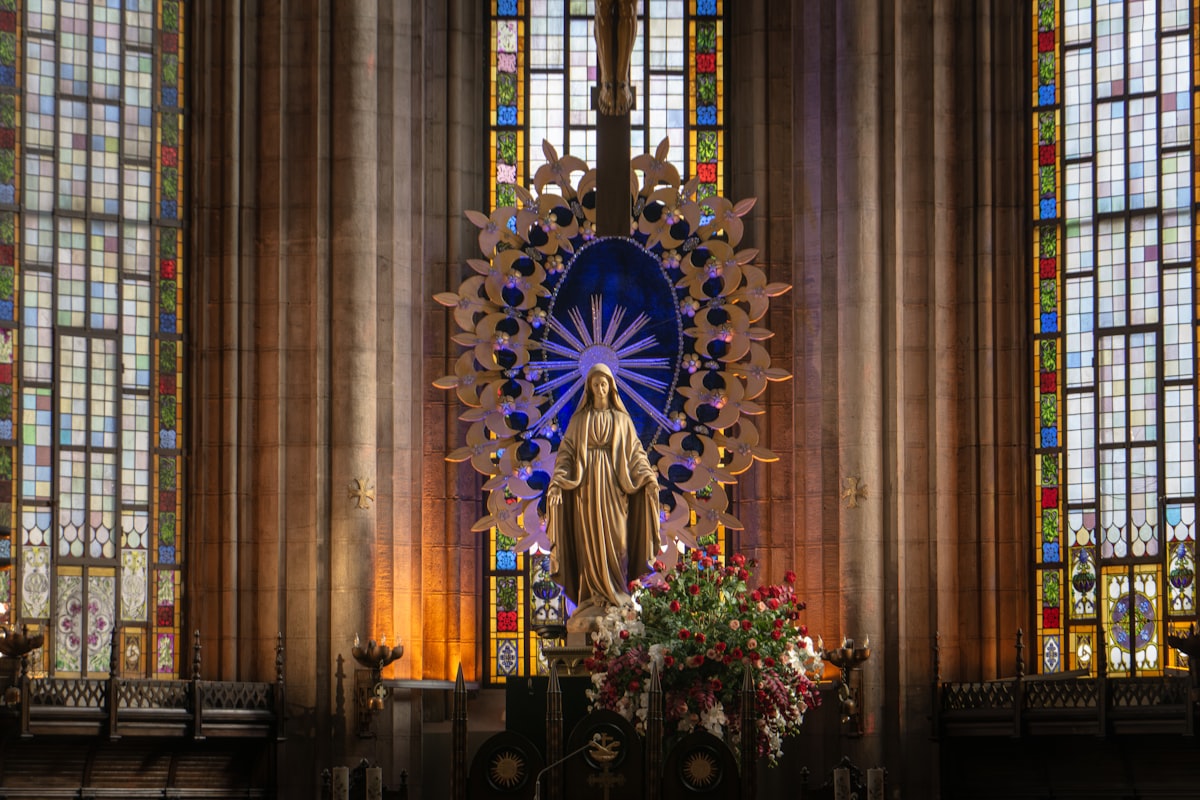
Every May, thousands of barangay chapels and parish churches across the Philippines fill with children carrying fresh flowers and adults kneeling in prayer. The air smells of sampaguita and roses. Someone leads the Rosary. Someone else holds a candle. This is Flores de Mayo — one of the Philippines' oldest and most widely practiced Catholic traditions, and one of the few that manages to feel both deeply religious and thoroughly communal at the same time.
This article explains what Flores de Mayo is, where it came from, how it is celebrated across the country, and what the Santacruzan — its grand culmination — actually involves. If you are looking for the Santacruzan specifically, continue to Santacruzan Meaning in the Philippines.
What does Flores de Mayo mean?
Flores de Mayo is Spanish for Flowers of May. The name captures the tradition's core act: offering flowers — usually fresh, local blooms — to a statue or image of the Virgin Mary throughout the month of May.
The phrase is used in the Philippines almost exclusively in its Spanish form. You rarely hear it translated into Filipino in everyday conversation, though the word bulaklak (flower) appears in related prayers and songs. The Spanish name is part of what gives the tradition its particular historical texture — a reminder that this practice arrived with the colonial church and took root deeply enough to outlast the colony by centuries.
History and origin of Flores de Mayo in the Philippines
European roots and Marian devotion
The tradition of honoring Mary in May has deep roots in European Catholicism. Long before the Philippines, May was already associated with Marian piety across Spain, Portugal, and Italy — a theological and cultural habit that positioned the spring month as the Virgin's own.
Spanish missionaries carried this devotion to the Philippines during the colonial period, introducing flower offerings to Mary as a way to blend indigenous appreciation for nature with Catholic teaching. The practice gradually took hold in Filipino communities, particularly in the provinces.
The 1854 proclamation and the surge in Marian devotion
A key moment in the tradition's growth came in 1854, when Pope Pius IX formally proclaimed the dogma of the Immaculate Conception — the teaching that Mary was conceived without original sin. The proclamation energized Marian devotion worldwide, and in the Philippines it accelerated the spread and formalization of May devotions.
Mariano Sevilla and the 1867 formalization in Bulacan
The Flores de Mayo tradition as practiced in the Philippines today is often traced to Fr. Mariano Sevilla, a Filipino Augustinian friar who in 1867 published a Tagalog translation of a Spanish Marian prayer book called Flores de Maria. Sevilla's work gave Filipino communities a structured set of prayers, hymns, and flower-offering rites that could be followed throughout May — and the tradition spread from Bulacan across Luzon and eventually the rest of the country.
This history matters because it shows that Flores de Mayo is not a purely imported tradition. Filipino religious writers and communities shaped it into something distinctly local — with its own songs, rituals, and regional flavors.
When is Flores de Mayo celebrated?
Flores de Mayo spans the entire month of May, from May 1 through May 31. It is not a single-day event but a month-long observance, with daily (or near-daily) activities culminating in the Santacruzan at the end of the month.
The month of May itself carries special significance in Filipino Catholicism. It also contains:
- May 1 — Labor Day, often observed with a church Mass
- May 13 — Feast of Our Lady of Fatima, particularly noted in some communities during Flores de Mayo
- Last week or last Sunday of May — Santacruzan procession in most communities
Flores de Mayo does not appear on the list of Philippine public holidays. It is a religious and cultural observance — widely practiced but not an official day off.
What happens during Flores de Mayo?
The daily structure of Flores de Mayo varies by community, but most observances follow a familiar pattern:
Flower offerings
Each evening during May, community members — particularly children — gather at a church, chapel, or neighborhood shrine to offer flowers to a statue of the Virgin Mary. The flowers are carried in procession, presented to the image, and arranged at the altar. Any seasonal flowers can be used: roses, gumamela, sampaguita, bougainvillea, or whatever is locally available.
The act of offering flowers is both symbolic and practical. Theologically, it represents love, purity, and gratitude to Mary. Culturally, it gives children an active role in a religious ceremony — making faith something participatory rather than passive.
The Rosary and Marian hymns
Flower offerings are accompanied by the recitation of the Rosary and the singing of traditional Marian hymns. The songs vary by region and community but often include the Salve Regina, the Litania ng Mahal na Birhen, and local hymns particular to the parish or the tradition's regional form.
In Bicol, a specific prayer called the Martía is recited after the Salve Regina and Litania, and traditional sung prayers called Alabasyón — from the Spanish alabar, meaning "to praise" — are a distinct feature of the regional celebration.
Catechism for children
Flores de Mayo has historically been used as a seasonal catechism opportunity. Children attending the nightly ceremonies are taught stories about the Virgin Mary, Christian virtues, and the meaning of Marian devotion. This teaching role is particularly prominent in the Visayas, where some communities use a formal participation system — children receive tickets for attending, which they redeem at month's end for school supplies.
Community gathering and meryenda
After the prayers and offerings, communities typically share food. A simple meryenda (afternoon or evening snack) — rice cakes, kakanin, or juice — is laid out for the children who participated. This social dimension is part of what makes Flores de Mayo feel less like a formal church obligation and more like a neighborhood tradition that families look forward to each year.
The Santacruzan: the grand culmination
If Flores de Mayo is the month, the Santacruzan is the finale — a dramatic religious procession and pageant that caps the entire May observance, usually held in the last week or on the last day of May.
What the Santacruzan commemorates
The Santacruzan re-enacts the legend of Saint Helena (Santa Elena), mother of the Roman Emperor Constantine the Great, and her famous journey in the 4th century to find the True Cross — the cross on which Jesus was crucified. In the Filipino tradition, Saint Helena is called Reyna Elena (Queen Helena), and her role is the most honored position in the procession.
The name Santacruzan comes from Santa Cruz, meaning Holy Cross — the object of the legendary search.
The sagalas: who they are and what they represent
The heart of the Santacruzan is the sagalas — young women and girls chosen to embody various biblical, historical, and allegorical figures. Each sagala is assigned a title and carries a symbolic object. They walk in procession beneath arched canopies of flowers, dressed in formal Filipiniana gowns or the terno.
Key sagala roles include:
| Title | Represents | Symbol |
|---|---|---|
| Reyna Elena | Saint Helena, finder of the True Cross | Cross; accompanied by a boy as Constantine |
| Reyna Fe | Faith | Cross |
| Reyna Esperanza | Hope | Anchor |
| Reyna Caridad | Charity | Heart |
| Reyna Justicia | Justice | Scale and sword |
| Reyna de las Flores | Queen of Flowers | Bouquet of flowers |
| Reyna Mora | Represents interfaith heritage | Crescent and star |
| Reyna Abogada | The Advocate | Legal documents or scroll |
| Reyna Sentenciada | The Condemned | Chains |
| Reyna de las Estrellas | Queen of the Stars | Crown of stars |
The number of sagalas varies by community — smaller barangays may have a dozen; larger town celebrations may feature 30 or more.
The procession
The Santacruzan procession moves through the streets of the town or barangay, often accompanied by a brass band playing a mix of solemn and festive music. Participants walk in order, with the most important sagala (Reyna Elena) typically at or near the end of the procession as its centerpiece. The route passes through the neighborhood and returns to the church for a closing Mass or blessing.
In many towns, the Santacruzan is also a social event: families compete for the honor of sponsoring a sagala, and community members line the streets to watch. In this way, the procession serves simultaneously as a religious rite, a community parade, and a display of local beauty and tradition.
Regional variations across the Philippines
Flores de Mayo is celebrated nationwide, but how it looks varies significantly by region — reflecting the Philippines' deep cultural diversity.
| Region | Character | Notable Features |
|---|---|---|
| Luzon (esp. Metro Manila, Bulacan) | Grand and social | Elaborate Santacruzan with floral arches; prominent families sponsor sagalas; large public celebrations; orchestras |
| Bicol | Prayer-focused | Martía prayer, Alabasyón hymns, katapusan (last-day Mass and procession); simpler and more devotional |
| Visayas (esp. Iloilo) | Education-focused | Daily catechism sessions; children earn participation tickets redeemable for school supplies; intimate gatherings |
In urban areas like Metro Manila, the Santacruzan often takes on a larger social dimension — a community beauty pageant as much as a religious procession, with elaborate gowns, formal sponsors, and significant community investment. In rural communities, the scale is smaller but the devotional character is often more intact.
Flores de Mayo and Filipino Catholic identity
The Philippines is the only predominantly Catholic country in Asia, and Flores de Mayo is one of the clearest expressions of how Filipino Catholicism developed — not as a straight transplant from Spain, but as a creole of Spanish colonial religion, indigenous community practice, and local creativity.
Several things make the Filipino Flores de Mayo distinct from its European counterparts:
- The Santacruzan — the pageant element has no direct Spanish equivalent and is uniquely Filipino
- Community catechism as a core function — integrating religious education with the celebration is a particularly Filipino adaptation
- The role of children — Filipino Flores de Mayo gives children a central, visible, active role that goes beyond passive participation
- Regional adaptation — the tradition absorbed local prayers, hymns, and ritual forms rather than remaining uniform
The tradition has also shown staying power precisely because it is not purely institutional. It lives in barangay chapels, neighborhood shrines, and parish courtyards as much as in formal churches — kept alive by communities, families, and local leaders rather than only by the clergy.
How to participate in Flores de Mayo
If you want to participate or introduce a child to Flores de Mayo:
- Find the schedule at your nearest parish. Most churches announce Flores de Mayo activities for May. Some have nightly ceremonies; others hold them weekly.
- Bring flowers. Fresh flowers are the traditional offering. Simple seasonal blooms are appropriate — you do not need expensive arrangements.
- Attend with children. The tradition is designed with children in mind. Bringing young family members and letting them present the flowers is the most direct way to participate.
- Join the Santacruzan if invited. Participation as a sagala or sponsor is usually arranged through the parish or barangay. Express interest early if you or a family member wants to take part.
- Stay for the community gathering. The social portion after the prayers is as important as the formal ceremony. This is where the tradition's communal character comes through most clearly.
Frequently asked questions
What is Flores de Mayo in the Philippines?
Flores de Mayo is a month-long Catholic tradition celebrated every May in honor of the Virgin Mary. Communities gather daily to offer flowers, pray the Rosary, sing Marian hymns, and participate in catechism. The tradition culminates in the Santacruzan procession at the end of the month.
What does Flores de Mayo mean?
The name is Spanish for Flowers of May. It refers both to the act of offering flowers to the Virgin Mary and to the broader month-long devotion.
When is Flores de Mayo celebrated?
Flores de Mayo spans the entire month of May, from May 1 to May 31, with the Santacruzan typically held in the last days of the month.
Is Flores de Mayo the same as Santacruzan?
No — they are connected but distinct. Flores de Mayo refers to the full month-long devotion and its daily traditions. The Santacruzan is a specific religious procession and pageant held at the end of Flores de Mayo as its grand culmination.
Who started Flores de Mayo in the Philippines?
The tradition was introduced by Spanish missionaries during the colonial period and formally shaped by Fr. Mariano Sevilla's 1867 Tagalog translation of Flores de Maria, published in Bulacan. The 1854 proclamation of the Immaculate Conception by Pope Pius IX also accelerated its spread.
Who are the sagalas in the Santacruzan?
Sagalas are the young women and girls chosen to represent biblical, historical, and allegorical figures in the Santacruzan procession. The most important role is Reyna Elena, who represents Saint Helena and carries a cross.
Is Flores de Mayo celebrated outside the Philippines?
Yes. Filipino communities abroad — in the United States, Canada, and other countries with significant Filipino diaspora populations — often organize their own Flores de Mayo and Santacruzan celebrations, typically through Filipino parishes or community organizations.
How is Flores de Mayo different in Bicol and Visayas?
In Bicol, the celebration is more prayer-focused, featuring specific Bicol-tradition hymns (Alabasyón) and prayers (Martía) not common elsewhere. In the Visayas, particularly Iloilo, the celebration emphasizes catechism for children, with participation tickets redeemable for school supplies — a unique local adaptation designed to encourage children's attendance.