
Philippine Independence Day 2026 is on Friday, June 12, 2026. It is a regular national holiday and one of the strongest moments in the calendar to talk about Filipino pride: not as empty slogan, but as something practiced through memory, language, food, craft, family, community, and civic responsibility.
Celebrating Filipino pride on Philippine Independence Day can be simple. Display the flag respectfully. Cook a dish from your province. Call an OFW relative. Teach a child one fact about June 12. Wear Filipino-made clothing or accessories. Read about the Aguinaldo Shrine. Support a local maker. Ask your family what freedom means in daily life now.
For a practical activity list, read Philippine Independence Day 2026 Activities and Fun Facts. For the fuller history, read Philippine Independence Day: Meaning, History, and How It Is Observed.
TL;DR: Filipino pride ideas for June 12
- Display the flag respectfully and teach one rule about it.
- Cook Filipino food and name the region or family story behind it.
- Wear something Filipino-made: barong, local textile, local jewelry, woven bag, or local shirt.
- Call an OFW family member and talk about home.
- Teach one local word or phrase to a child.
- Visit a monument, museum, plaza, or historical marker nearby.
- Support a Filipino maker, writer, farmer, artist, or small business.
- Share a thoughtful post online instead of a generic greeting.
- Ask one reflection question: what does freedom ask from us now?
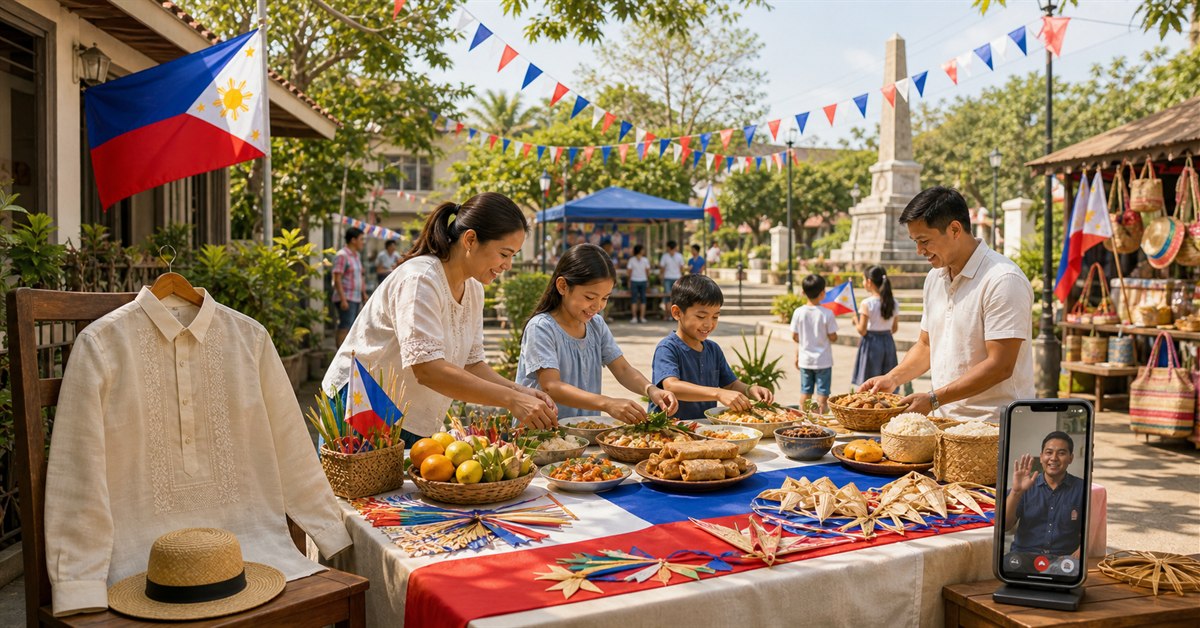
Filipino pride is strongest when it connects national symbols to family, work, language, craft, and everyday responsibility.
Table of contents
- What Filipino pride can mean on June 12
- Meaningful ways to celebrate Filipino pride
- For OFW and diaspora families
- For kids and students
- For online posts and captions
- What to avoid
- Sources and context
- FAQs
What Filipino pride can mean on June 12
Filipino pride is easy to say but harder to define. On Independence Day, it should be more than “Proud to be Pinoy” posted once a year. Pride can be gratitude for people who fought before us. It can be care for the flag. It can be speaking a local language without shame. It can be buying Filipino-made goods when possible. It can be respecting workers, farmers, teachers, artists, nurses, seafarers, and OFWs whose labor carries families and communities.
June 12 remembers the 1898 proclamation of independence in Kawit, Cavite. That historical moment was not the end of the Filipino struggle for sovereignty, but it remains a powerful assertion: Filipinos declared themselves a people with the right to govern their own future.
That is why the best Independence Day celebrations are both joyful and reflective. Food, music, clothes, crafts, and community events are welcome. But the day also asks a deeper question: what do we do with the freedom we inherited?
Meaningful ways to celebrate Filipino pride
1. Display the Philippine flag properly
The flag is the most visible national symbol of the day. If your household displays it, do so respectfully. Keep it clean, secure, and off the ground. In peacetime, the blue field is placed above the red when displayed horizontally.
This can be a short teaching moment. Ask younger family members: what do the sun and stars represent? Why does the flag have rules? What is the difference between using national colors respectfully and treating the flag like disposable decoration?
2. Cook a regional dish
Food is one of the easiest ways to connect pride with memory. Cook something that represents your family, province, or childhood: Bicol Express, laing, pancit, adobo, sinigang, inasal, kinilaw, kakanin, batchoy, pinakbet, piyaya, or whatever dish feels like home.
Before eating, ask one person to explain where the dish comes from or who taught the family to cook it. That turns lunch into oral history.
3. Wear Filipino-made pieces
Filipino pride can be worn without becoming costume-like. A barong, local textile, woven bag, local leather wallet, handmade jewelry, Filipino-designed shirt, or locally made sandals can all be meaningful when worn with respect.
If you want a more formal cultural piece, read Barong Tagalog: What It Is, What It’s Made Of, and When to Wear It or Best Barong Tagalog Brands Philippines 2026.
4. Learn one local word or phrase
The Philippines is not one language or one accent. Filipino pride includes Tagalog, Cebuano, Ilocano, Hiligaynon, Waray, Kapampangan, Bikol, Pangasinan, Tausug, Maranao, Chavacano, and many more languages and varieties.
On June 12, teach one word from your family’s language to a child or friend. It can be a greeting, a food word, a phrase of thanks, or an old word grandparents still use. Language is a form of inheritance.
5. Visit one local place with history
You do not need to travel far. A plaza, old church, city hall, monument, museum, marker, ancestral house, school, or cemetery can reveal a local story. Read the plaque. Search the name. Ask why the place is important.
The best pride is not abstract. It notices the history already present in the neighborhood.
6. Support Filipino work
Support can be as simple as buying from a local bakery, sari-sari store, maker, farmer’s market, bookstore, artist, clothing brand, or family-run restaurant. If you cannot buy, share a Filipino creator’s work, recommend a local business, or leave a fair review.
This is especially meaningful before and after June 12, when interest in Filipino-made products rises. Pride becomes concrete when it supports real Filipino labor. For practical product ideas, use Best Filipino-Made Products to Buy and Support Local 2026.
7. Watch or read something about Philippine history
Choose one short reading, documentary, museum article, or credible explainer. You do not need to solve every historical debate in one day. Learn one detail well: Kawit, Aguinaldo, the flag, the anthem, the shift from July 4 to June 12, or the role of local revolutionaries.
Then ask: what did I learn that I did not know before?
8. Make the day intergenerational
Invite older relatives into the conversation. Ask what Independence Day was like when they were students. Ask what they remember from school flag ceremonies. Ask what changed in the neighborhood. Ask what Filipino values they want younger people to keep.
This is not nostalgia for its own sake. It is a way to connect national history to family memory.
9. Do something useful for the community
Pride can be service. Clean a shared space, donate books, help a neighbor, support a community pantry, volunteer, or join a barangay activity. A small act can make the day feel less performative.
Freedom is not only the right to celebrate. It is also the responsibility to care for one another.
For OFW and diaspora families
Philippine Independence Day can feel different when someone in the family is abroad. For OFWs, migrants, seafarers, nurses, caregivers, engineers, teachers, and students overseas, Filipino pride often lives in video calls, remittances, food, language, and small home rituals. For the economic and family context behind that sacrifice, read Why OFWs Are the Heart of the Philippine Economy.
Simple ideas:
- Schedule a June 12 family video call.
- Cook the same Filipino dish in two countries.
- Ask the OFW relative what they miss most about home.
- Share photos of flag displays or family meals.
- Teach children abroad one Filipino phrase.
- Talk about what “home” means when family is spread across borders.
Avoid turning the OFW story into empty hero language. Many overseas Filipinos carry pride and sacrifice at the same time. Let the conversation be honest.
For kids and students
Children learn pride best through specific, memorable actions. Try:
- Drawing or making a paper flag while learning its parts.
- Naming Luzon, Visayas, and Mindanao on a map.
- Asking grandparents one Independence Day question.
- Reading one short biography of a hero or local figure.
- Learning a regional song or word.
- Writing one sentence that starts with “I can help my country by...”
The last prompt matters. It moves the holiday from memory into action.
For online posts and captions
It is fine to post on Independence Day. The better question is whether the post adds meaning.
Good post ideas:
- A family story connected to June 12
- A photo of a properly displayed flag
- A local historical place
- A Filipino-made product or craft
- A short reflection on language, food, or family
- A thank-you to teachers, workers, or elders
- A question that invites thoughtful discussion
Avoid using the flag as a meme, background clutter, or costume prop. Avoid spreading fake quotes or inaccurate history. If you share facts, link to credible sources.
Short caption ideas:
- “Today I’m grateful for the people, languages, food, work, and stories that make home feel like home.”
- “Kalayaan is history, but it is also daily responsibility.”
- “Celebrating June 12 by learning one family story and supporting one local maker.”
- “Proud to be Filipino, and still learning what that asks of me.”
What to avoid
Treating pride as only performance
Posting a flag once a year is easy. Living with respect for fellow Filipinos is harder. Let the day push beyond slogans.
Using national symbols carelessly
The flag has rules. Avoid using it as a tablecloth, costume, wrapper, floor decoration, or disposable party prop. Use national colors freely, but treat the actual flag with respect.
Turning the holiday into pure sales language
Promos happen around holidays, but brands and creators should avoid using Independence Day only as a discount theme. If selling, connect it to Filipino work, local supply chains, craft, or community.
Flattening Filipino identity
Filipino pride is not only one language, one food, one region, one skin tone, one accent, or one political opinion. The country is diverse. A more mature pride leaves room for many ways of being Filipino.
Sources and context
- The Official Gazette holiday page is used for the 2026 holiday context.
- Republic Act No. 4166 is used for the legal basis establishing June 12 as Philippine Independence Day.
- The National Historical Commission of the Philippines Aguinaldo Shrine page is used for Kawit, Cavite historical-site context.
- Republic Act No. 8491 is used for flag and heraldic-code context.
- For practical June 12 ideas, read Philippine Independence Day 2026 Activities and Fun Facts.
FAQs
When is Philippine Independence Day 2026?
Philippine Independence Day 2026 is on Friday, June 12, 2026. June 12 is observed every year as a regular national holiday in the Philippines.
How can Filipinos celebrate Independence Day meaningfully?
Filipinos can celebrate meaningfully by displaying the flag respectfully, learning the history of June 12, speaking and preserving local languages, supporting Filipino-made work, cooking regional food, visiting historical places, and sharing family stories.
What does Filipino pride mean on Independence Day?
Filipino pride can mean honoring history while practicing everyday responsibility: respecting the flag, valuing local culture, helping community, protecting language, supporting honest Filipino work, and asking what freedom requires today.
What can OFW families do for Independence Day?
OFW families can schedule a video call, cook the same Filipino dish in different countries, exchange family stories, send photos of flag displays, or talk about what home and freedom mean while living abroad.
Is it okay to post about Independence Day online?
Yes, but keep it respectful. Use the day to share a thoughtful reflection, family history, Filipino-made work, a local place, a language lesson, or a simple greeting instead of turning the flag into a disposable meme.
What should we avoid on Philippine Independence Day?
Avoid disrespecting the flag, spreading false history, using the holiday only for sales without meaning, treating national symbols as costumes or props, and arguing online without learning the context.
Final thought
Philippine Independence Day 2026 is a good day to celebrate, but also a good day to listen. Filipino pride is in the flag, yes, but also in food cooked by family, languages kept alive, work done honestly, local places remembered, and communities cared for. If June 12 helps even one person learn a story, call home, support local, or treat a national symbol with more respect, the day has done something useful.
Deeper buying and planning guide
Philippine Independence Day 2026: Celebrating Filipino Pride on June 12 needs to balance tradition with real-life variation. Filipino customs are not identical in every province, school, church, office, or family, so a useful guide explains the common meaning while still leaving room for local practice.
The primary keyword focus is Philippine Independence Day 2026: Celebrating Filipino Pride, but the page should also answer related search intent naturally: who it is for, when it matters, what to check first, what to avoid, and how to adapt the advice in the Philippines. For AI SEO, the goal is not to repeat the keyword mechanically. The goal is to give clear, extractable answers that can stand alone in a search snippet, AI Overview, or chatbot summary without losing the practical context.
How to make a smart decision
Start with the situation, not the product or idea. A student, a parent, a commuter, a remote worker, and a holiday host may all search for Philippine Independence Day 2026: Celebrating Filipino Pride on June 12, but they do not need the same answer. The best decision comes from matching the recommendation to budget, timing, risk, and the consequence of getting it wrong. If a cheap option fails after one week, it may cost more than a mid-range choice. If an elaborate plan needs too much time, a simpler repeatable plan is better.
Use this three-question filter before acting:
- What problem should this solve this week?
- What detail can change before I buy, travel, cook, attend, or prepare?
- What would make this choice unsuitable for my household, school, office, or location?
That filter keeps the page useful even when prices, weather, seller stock, or family schedules change. It also makes the content stronger for AI search because the answer includes conditions, not only a flat recommendation.
Philippines-specific checklist
| Check | What to do | Why it matters |
|---|---|---|
| Requirement | Write down the real use case before comparing options | Prevents buying for a fantasy version of the week |
| Budget ceiling | Set the maximum total cost including shipping or extras | Keeps the decision realistic |
| Verification | Check seller, date, policy, size, and current availability | Avoids outdated or misleading claims |
| Local adaptation | Adjust for school, office, barangay, family, or transport rules | Philippine routines vary by place |
| After-use review | Keep what worked and remove what did not | Makes the next decision faster |
Fact-check and source notes
For culture and holiday pages, dates and official observances should be checked against government sources, especially when a post mentions a 2026 calendar. Historical context should be separated from family practice because Filipino traditions vary by region, religion, school, workplace, and household. Philippine Independence Day 2026: Celebrating Filipino Pride on June 12 uses that conservative approach: explain the common pattern, note where rules can change, and avoid treating one family's custom as the national standard.
Sources used for this fact-check layer:
- NHCP materials on Philippine independence and nationhood
- Supreme Court E-Library copy of Proclamation No. 1006, s. 2025 for 2026 holidays
- DTI online shopping safety tips
- DTI e-commerce FAQs on seller checks, returns, and complaints
The safest rule is to separate stable guidance from changeable details. Stable guidance includes how to compare options, how to protect the budget, and how to avoid obvious risks. Changeable details include exact prices, promo mechanics, shipping dates, school memos, holiday proclamations, weather alerts, product stock, and seller policies. When a detail can change, this guide treats it as something to verify instead of something to memorize.
SEO and AI-search answer structure
For traditional SEO, Philippine Independence Day 2026: Celebrating Filipino Pride on June 12 should include the main keyword in the title, introduction, headings, and supporting copy without stuffing. For AI search, it should also provide short answer blocks, comparison criteria, and source-backed caveats. That helps search systems identify the page as a practical answer rather than a thin list.
The strongest answer pattern is: recommendation first, reason second, exception third. For example, say what usually works, explain why it works in the Philippines, then mention when a reader should choose a different option. This is clearer than a long paragraph that hides the actual answer.
Existing quick-answer points to preserve:
- When is Philippine Independence Day 2026?: Philippine Independence Day 2026 is on Friday, June 12, 2026. June 12 is observed every year as a regular national holiday in the Philippines.
- How can Filipinos celebrate Independence Day meaningfully?: Filipinos can celebrate meaningfully by displaying the flag respectfully, learning the history of June 12, speaking and preserving local languages, supporting Filipino-made work, cooking regional food, visiting historical places, and sharing family stories.
- What does Filipino pride mean on Independence Day?: Filipino pride can mean honoring history while practicing everyday responsibility: respecting the flag, valuing local culture, helping community, protecting language, supporting honest Filipino work, and asking what freedom requires today.
- What can OFW families do for Independence Day?: OFW families can schedule a video call, cook the same Filipino dish in different countries, exchange family stories, send photos of flag displays, or talk about what home and freedom mean while living abroad.
Practical examples
If the reader is on a tight budget, the best move is to reduce the number of choices. Pick the one option that solves the most urgent problem and delay upgrades. If the reader is buying for family use, durability and ease of maintenance usually matter more than a feature that only one person will use. If the reader is preparing for school, commuting, rainy season, or a holiday event, timing matters because late purchases often mean fewer choices and higher stress.
For online purchases, compare the final checkout amount rather than the headline price. Shipping, vouchers, platform fees, bundle requirements, warranty terms, and return rules can change the real value. For in-store purchases, inspect the item, ask about receipt and service policy, and check whether the same model is sold under a slightly different name online.
Common weak spots to avoid
Do not rely on one viral recommendation. Do not assume the most expensive option is automatically the best. Do not treat old prices as current. Do not ignore return policies. Do not buy a product or follow a plan only because it looks good in photos. Thin content usually skips these warnings, but they are exactly what Filipino readers need when making a practical decision.
A stronger page also avoids fake certainty. If there is no official price, say prices vary. If a practice differs by region, say it differs. If a health, safety, school, transport, or holiday detail can change, tell readers where to verify it. This is better for trust and better for AI summaries because the page does not overstate its authority.
Short answers for AI search
What is the fastest way to use Philippine Independence Day 2026: Celebrating Filipino Pride on June 12?
Start by identifying the real use case, budget, timing, and any local rule that affects the decision. Then compare only the options that match those limits.
What should readers fact-check before following Philippine Independence Day 2026: Celebrating Filipino Pride on June 12?
Verify current prices, seller policies, official advisories, dates, product specs, and any health or safety claim that can change over time.
How does this guide help with AI search results?
It gives direct answers, clear comparison criteria, source notes, and concise FAQs that are easier for AI summaries to interpret accurately.
What is the most common mistake?
The most common mistake is copying a generic recommendation without checking whether it fits the reader's location, budget, schedule, and actual need.
What makes this advice practical in the Philippines?
It accounts for changing prices, weather, transport, school or office rules, and household budgets instead of assuming perfect conditions.
Bottom-line recommendation
Use Philippine Independence Day 2026: Celebrating Filipino Pride on June 12 as a practical starting point, then verify the details that can change before acting. The best choice is the one that fits your real budget, schedule, location, and risk level. If two options look similar, choose the one with clearer terms, better evidence, easier after-sales support, and fewer hidden costs.
A useful editorial check for Philippine Independence Day 2026: Celebrating Filipino Pride on June 12 is whether a reader can act after one pass. If the page only says what is nice, it is still thin. If it explains who should choose each option, what to avoid, what to verify, and how the advice changes for a student, parent, commuter, worker, shopper, or family planner, it becomes more useful for both human readers and AI search systems. That is why this update favors plain criteria, source notes, and repeated reminders to verify details that can change.