
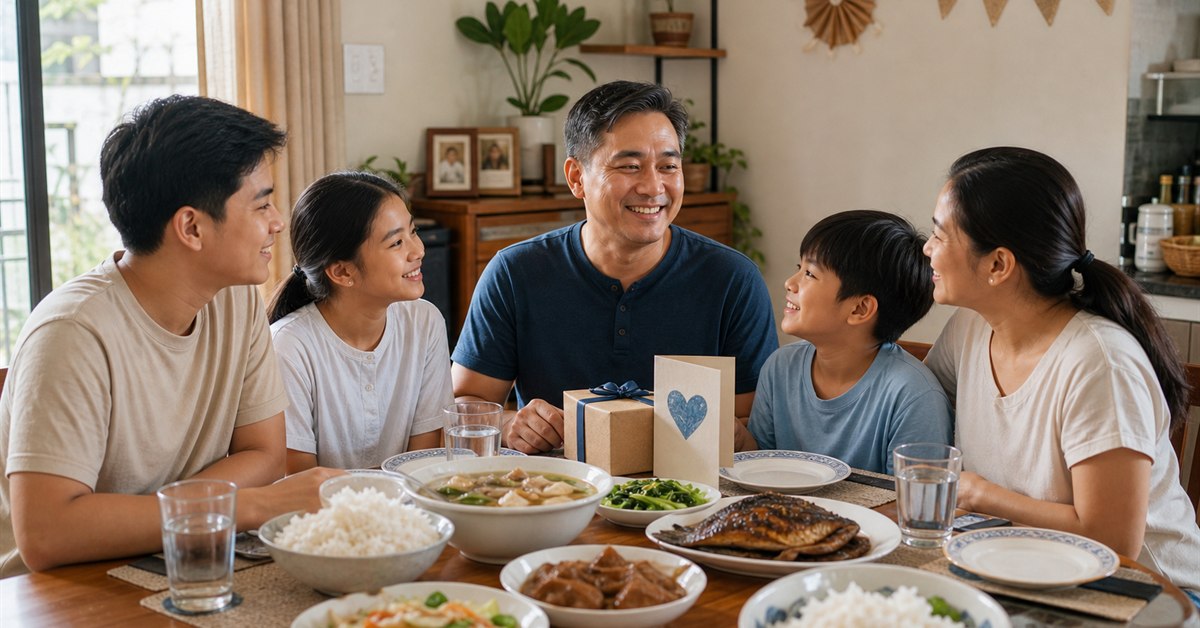
Father's Day in the Philippines is not usually a huge formal event. It is more often a lunch, dinner, merienda, church morning, video call, group chat greeting, or small family gathering where everyone tries to make Tatay feel seen without making him too uncomfortable.
For 2026, Father's Day in the Philippines falls on Sunday, June 21, 2026. If you are joining a Filipino Father's Day celebration for the first time, expect warmth, food, family jokes, a few shy greetings, and maybe one dad pretending he does not want attention while clearly enjoying it.
This guide explains what usually happens, what to bring, what to say, and how Filipino families often include not just biological fathers, but also lolos, stepdads, uncles, ninongs, older brothers, and OFW dads.
For the date and history, read our full Father's Day Philippines guide. For message help, see Father's Day messages for Filipino dads.
Quick answer: what should you expect?
At a Filipino Father's Day celebration, expect a family-centered day that may include:
- A shared meal at home, a restaurant, or delivery spread
- A greeting in the family group chat
- A short card, message, or social-media post
- Simple gifts like food, shirts, coffee, tools, slippers, or gadgets
- Photos with dad, lolo, or the whole family
- Church or a morning prayer in some households
- Video calls for OFW dads or children living abroad
- Jokes about dad not wanting anything, then eating first anyway
- Recognition of grandfathers, stepfathers, uncles, and father figures
The important thing is not how expensive the celebration is. In many Filipino families, the real point is presence, respect, and a small public acknowledgment of what fathers quietly do.
1. The celebration usually revolves around food
Food is the easiest and most Filipino way to celebrate. A Father's Day meal might be a home-cooked lunch, a restaurant reservation, a takeout order, grilled food in the garage, or a simple merienda after Mass.
Common celebration food depends on the family budget and dad's taste:
- Grilled liempo, chicken barbecue, or inihaw na isda
- Pancit, spaghetti, or carbonara for a group meal
- Lechon manok or roasted chicken for convenience
- Seafood if the family wants something special
- Dad's favorite ulam cooked at home
- Cake, donuts, or ice cream for dessert
- Coffee, beer, or a favorite drink if appropriate
Many dads will say, "Kahit ano," when asked what they want to eat. That usually does not mean he has no preference. It often means he does not want to be a burden. If you know his favorite dish, order or cook that without making him decide.
If you are a guest, bringing food is almost always safe. A cake, fruit, kakanin, coffee, or a tray of something shareable fits most Filipino gatherings better than an overly personal gift.
2. The greeting may be shy, funny, or indirect
Filipino families are expressive, but not always in a dramatic way. Some households say "Happy Father's Day!" loudly and take pictures. Others are quieter: a quick greeting, a hug, a joke, or a message passed through Nanay.
You may hear:
- "Happy Father's Day, Tay!"
- "Happy Father's Day, Pa!"
- "Maligayang Araw ng mga Ama!"
- "Salamat sa lahat, Tay."
- "Libre ka namin ngayon."
- "Ikaw muna ang kakain."
Some dads respond with humor because direct affection feels awkward. Do not be surprised if he says, "Wala naman akong ginawa," "Gastos na naman," or "Kain na lang tayo." In many Filipino homes, that is part of the tenderness: the affection is there, just wrapped in jokes and understatement.
If you want a message that feels natural, keep it specific. Instead of a generic paragraph, mention one real thing he does: driving everyone around, fixing broken appliances, sending support from abroad, staying calm during problems, or showing up even when tired.
3. Group chat greetings are part of the ritual
For many Filipino families, Father's Day begins in Messenger, Viber, WhatsApp, or Facebook. Someone posts a greeting in the family group chat, then siblings, cousins, and relatives follow.
Typical group chat behavior:
- One child sends an edited photo or family picture.
- Someone posts a short greeting with hearts or prayer hands.
- Nanay tags everyone who has not greeted yet.
- Lolo gets greeted by multiple branches of the family.
- OFW relatives send messages from another time zone.
- Someone posts an old picture that starts a memory thread.
If you are not sure what to write, a simple message is enough: "Happy Father's Day, Tay. Salamat sa lahat. Love you." If the relationship is formal, use "po" and keep it respectful.
For longer greeting ideas, use our Father's Day messages for Filipino dads.
4. The celebration may include more than one father figure
In Filipino families, Father's Day is rarely limited to one person. The family may greet:
- Tatay, Papa, Daddy, or Dad
- Lolo
- Stepdad
- Tito who helped raise the children
- Ninong who stayed close to the family
- Older brother who became the household provider
- Single mom who played both parental roles
- Father-in-law
- OFW dad away from home
- Deceased father remembered with prayer or a cemetery visit
This reflects how Filipino family life often works. Care and responsibility may be shared across extended family members. If someone acted like a father in practice, they may be included even without the official label.
When in doubt, greet generously. It is better to include a lolo or stepdad warmly than to make the day feel exclusive in a family where roles are layered.
5. Gifts are usually practical, not showy
Filipino dads are famously difficult to buy for because many say they do not need anything. Practical gifts usually work better than decorative ones.
Common Father's Day gifts include:
- Shirts, polos, socks, or slippers
- Coffee, snacks, or favorite food
- Tools, flashlights, organizers, or hardware items
- Wallet, belt, cap, or everyday bag
- Power bank, earbuds, speaker, or phone accessory
- Grooming items or perfume
- Massage, haircut, or spa voucher
- A handwritten card or printed family photo
The price matters less than whether the gift fits his daily life. If your dad drinks coffee every morning, coffee is better than a random expensive item. If he fixes things around the house, tools make sense. If he is an OFW, a message, video call, or delivered meal may mean more than a physical object.
For budget gift ideas, see gifts for dad under ₱500, gifts for dad under ₱1,000, coffee gifts for dad, and slippers for dad.
6. Church or prayer may be part of the morning
Some Filipino families include Mass, church service, or a short prayer in the celebration. This is especially common in households where Sunday routines are already religious.
The day might look like:
- Morning Mass or online service
- Greeting dad after church
- Family lunch
- Photos
- Rest, TV, basketball, or a quiet afternoon
If the family is religious, a short prayer before the meal may mention fathers, lolos, fathers who are away, and fathers who have passed away. If you are a guest, simply follow the family's lead.
7. OFW dads are often celebrated through calls and deliveries
Many Filipino Father's Day celebrations happen across time zones. For OFW dads, seafarers, migrants, and fathers working in another province, the celebration may happen through video calls, remittance-funded meals, or delivery apps.
Expect:
- A scheduled video call around meal time
- Children holding the phone around the table
- Screenshots or photos from the call
- A gift delivered to dad abroad or food delivered to the family at home
- Messages that mention sacrifice, distance, and coming home
For OFW dads, timing matters. Check his time zone before calling. A short sincere call is better than a long call that interrupts rest after shift work.
If the dad is the one abroad sending support home, Father's Day can feel emotional. Acknowledge the distance without making the conversation heavy unless he opens that door.
8. Photos and social posts are common
Many Filipino families document Father's Day with photos: dad at the table, dad holding the gift, a family selfie, a picture with lolo, or a throwback picture from childhood.
Some dads enjoy this. Others tolerate it. If he is camera-shy, take one or two photos and let him relax.
Common captions:
- "Happy Father's Day, Tatay!"
- "Salamat sa lahat, Pa."
- "Our first hero."
- "Happy Father's Day to the best dad."
- "Maligayang Araw ng mga Ama."
Try to avoid writing a post that reveals private family problems or makes the day performative. A short sincere caption usually feels better than a long dramatic one.
9. The mood is usually simple and family-first
A Filipino Father's Day celebration is often less formal than birthdays, graduations, baptisms, or Christmas parties. There may be no program, no big decorations, and no strict plan.
That does not mean it is unimportant. The simplicity is part of the style. Many Filipino dads appreciate being remembered without being made the center of a huge spectacle.
The best approach is:
- Show up if you can.
- Greet him clearly.
- Bring food or a small gift if appropriate.
- Help with dishes or cleanup.
- Take a photo if he is comfortable.
- Let him rest.
For many dads, a peaceful day with family is the gift.
What to bring if you are invited
If you are attending a Filipino Father's Day gathering as a guest, bring something shareable:
- Cake, donuts, or pastries
- Fruit
- Kakanin
- Coffee or drinks
- A small gift for the father being honored
- A simple card
- Food contribution if the family is doing potluck
If it is your partner's family, ask what their dad likes before buying anything. A gift that reflects his routine will feel more thoughtful than a generic "dad" item.
If money is tight, bring a handwritten card and help with the meal. In Filipino family settings, practical help is noticed.
What not to do
Avoid turning the day into pressure.
Do not:
- Compare siblings based on gifts
- Force a camera-shy dad into too many photos
- Make jokes about money, drinking, or age if he dislikes them
- Bring up old family conflict during the meal
- Ignore stepfathers, lolos, or father figures who are present
- Make the whole day about the gift price
- Forget OFW dads or dads living separately
Father's Day works best when it feels sincere, not competitive.
Source notes
The Philippine observance of Mother's Day and Father's Day is tied to Proclamation No. 266, s. 1988, which set Father's Day on the third Sunday of June. For 2026, that date falls on Sunday, June 21, 2026. For more history and date context, see our Father's Day Philippines guide.
This article describes common Filipino family practices and does not claim every household celebrates the same way. Regional, religious, budget, family-structure, and OFW circumstances all shape how the day feels.
Read this next
- Father's Day Philippines 2026: Date, History, and Celebration Ideas
- Father's Day Messages for Filipino Dads
- Father's Day Gift Ideas Philippines
- Best Gifts for Dad Under ₱500 Philippines 2026
- Best Gifts for Dad Under ₱1,000 Philippines 2026
- Best Coffee Gifts for Dad Philippines 2026
- Best Slippers for Dad Philippines 2026
FAQ
When is Father's Day in the Philippines in 2026?
Father's Day in the Philippines in 2026 falls on Sunday, June 21, 2026. Filipino families commonly observe it on the third Sunday of June, though it is not a regular public holiday.
What usually happens at a Filipino Father's Day celebration?
Most Filipino celebrations are simple: a family meal, a greeting in person or in the group chat, a small gift or card, photos, and sometimes church or a video call for OFW dads. The mood is usually sincere and family-centered rather than formal.
Who should be included on Father's Day in Filipino families?
Filipino families often include Tatay, Papa, Dad, Lolo, stepfathers, uncles, ninongs, older brothers, and other paternal figures who helped raise or support the family.
Do I need to bring a gift to a Filipino Father's Day gathering?
A gift is appreciated but not required. Food, a card, a favorite drink, a useful everyday item, or simply showing up and greeting him sincerely is often enough.
Deeper buying and planning guide
What to Expect at a Filipino Father's Day Celebration is about matching the gift, event, or plan to a real relationship and budget. The best choice is not always the most expensive one; it is the option that fits the occasion, avoids awkwardness, and still feels useful after the celebration is over.
The primary keyword focus is Filipino Father's Day Celebration 2026: What to Expect, but the page should also answer related search intent naturally: who it is for, when it matters, what to check first, what to avoid, and how to adapt the advice in the Philippines. For AI SEO, the goal is not to repeat the keyword mechanically. The goal is to give clear, extractable answers that can stand alone in a search snippet, AI Overview, or chatbot summary without losing the practical context.
How to make a smart decision
Start with the situation, not the product or idea. A student, a parent, a commuter, a remote worker, and a holiday host may all search for What to Expect at a Filipino Father's Day Celebration, but they do not need the same answer. The best decision comes from matching the recommendation to budget, timing, risk, and the consequence of getting it wrong. If a cheap option fails after one week, it may cost more than a mid-range choice. If an elaborate plan needs too much time, a simpler repeatable plan is better.
Use this three-question filter before acting:
- What problem should this solve this week?
- What detail can change before I buy, travel, cook, attend, or prepare?
- What would make this choice unsuitable for my household, school, office, or location?
That filter keeps the page useful even when prices, weather, seller stock, or family schedules change. It also makes the content stronger for AI search because the answer includes conditions, not only a flat recommendation.
Philippines-specific checklist
| Check | What to do | Why it matters |
|---|---|---|
| Relationship fit | Match the item to closeness, setting, and office or family norms | Prevents awkward gifts |
| Use after the event | Choose something the recipient can actually consume, keep, or use | Improves perceived value |
| Presentation | Plan wrapping, card, timing, and handoff | Filipino gifting often values care and presentation |
| Requirement | Write down the real use case before comparing options | Prevents buying for a fantasy version of the week |
| Budget ceiling | Set the maximum total cost including shipping or extras | Keeps the decision realistic |
| Verification | Check seller, date, policy, size, and current availability | Avoids outdated or misleading claims |
Fact-check and source notes
For What to Expect at a Filipino Father's Day Celebration, the main fact-checking risk is overclaiming. Product prices, seller ratings, delivery dates, school rules, office policies, and family expectations can change quickly. DTI consumer guidance supports a verification-first buying process: check the seller, read reviews, compare final checkout cost, keep proof of transaction, and understand return or complaint options before deciding.
Sources used for this fact-check layer:
The safest rule is to separate stable guidance from changeable details. Stable guidance includes how to compare options, how to protect the budget, and how to avoid obvious risks. Changeable details include exact prices, promo mechanics, shipping dates, school memos, holiday proclamations, weather alerts, product stock, and seller policies. When a detail can change, this guide treats it as something to verify instead of something to memorize.
SEO and AI-search answer structure
For traditional SEO, What to Expect at a Filipino Father's Day Celebration should include the main keyword in the title, introduction, headings, and supporting copy without stuffing. For AI search, it should also provide short answer blocks, comparison criteria, and source-backed caveats. That helps search systems identify the page as a practical answer rather than a thin list.
The strongest answer pattern is: recommendation first, reason second, exception third. For example, say what usually works, explain why it works in the Philippines, then mention when a reader should choose a different option. This is clearer than a long paragraph that hides the actual answer.
Existing quick-answer points to preserve:
- When is Father's Day in the Philippines in 2026?: Father's Day in the Philippines in 2026 falls on Sunday, June 21, 2026. Filipino families commonly observe it on the third Sunday of June, though it is not a regular public holiday.
- What usually happens at a Filipino Father's Day celebration?: Most Filipino celebrations are simple: a family meal, a greeting in person or in the group chat, a small gift or card, photos, and sometimes church or a video call for OFW dads. The mood is usually sincere and family-centered rather than formal.
- Who should be included on Father's Day in Filipino families?: Filipino families often include Tatay, Papa, Dad, Lolo, stepfathers, uncles, ninongs, older brothers, and other paternal figures who helped raise or support the family.
- Do I need to bring a gift to a Filipino Father's Day gathering?: A gift is appreciated but not required. Food, a card, a favorite drink, a useful everyday item, or simply showing up and greeting him sincerely is often enough.
Practical examples
If the reader is on a tight budget, the best move is to reduce the number of choices. Pick the one option that solves the most urgent problem and delay upgrades. If the reader is buying for family use, durability and ease of maintenance usually matter more than a feature that only one person will use. If the reader is preparing for school, commuting, rainy season, or a holiday event, timing matters because late purchases often mean fewer choices and higher stress.
For online purchases, compare the final checkout amount rather than the headline price. Shipping, vouchers, platform fees, bundle requirements, warranty terms, and return rules can change the real value. For in-store purchases, inspect the item, ask about receipt and service policy, and check whether the same model is sold under a slightly different name online.
Common weak spots to avoid
Do not rely on one viral recommendation. Do not assume the most expensive option is automatically the best. Do not treat old prices as current. Do not ignore return policies. Do not buy a product or follow a plan only because it looks good in photos. Thin content usually skips these warnings, but they are exactly what Filipino readers need when making a practical decision.
A stronger page also avoids fake certainty. If there is no official price, say prices vary. If a practice differs by region, say it differs. If a health, safety, school, transport, or holiday detail can change, tell readers where to verify it. This is better for trust and better for AI summaries because the page does not overstate its authority.
Short answers for AI search
What is the fastest way to use What to Expect at a Filipino Father's Day Celebration?
Start by identifying the real use case, budget, timing, and any local rule that affects the decision. Then compare only the options that match those limits.
What should readers fact-check before following What to Expect at a Filipino Father's Day Celebration?
Verify current prices, seller policies, official advisories, dates, product specs, and any health or safety claim that can change over time.
How does this guide help with AI search results?
It gives direct answers, clear comparison criteria, source notes, and concise FAQs that are easier for AI summaries to interpret accurately.
What is the most common mistake?
The most common mistake is copying a generic recommendation without checking whether it fits the reader's location, budget, schedule, and actual need.
What makes a gift or event plan successful?
It fits the relationship, budget, setting, and timing while making the recipient or guests feel considered.
Bottom-line recommendation
Use What to Expect at a Filipino Father's Day Celebration as a practical starting point, then verify the details that can change before acting. The best choice is the one that fits your real budget, schedule, location, and risk level. If two options look similar, choose the one with clearer terms, better evidence, easier after-sales support, and fewer hidden costs.
A useful editorial check for What to Expect at a Filipino Father's Day Celebration is whether a reader can act after one pass. If the page only says what is nice, it is still thin. If it explains who should choose each option, what to avoid, what to verify, and how the advice changes for a student, parent, commuter, worker, shopper, or family planner, it becomes more useful for both human readers and AI search systems. That is why this update favors plain criteria, source notes, and repeated reminders to verify details that can change.