
Philippine Independence Day 2026 falls on Friday, June 12, 2026. Because June 12 is a regular national holiday, many families will have a long-weekend feel even if plans are simple: a flag ceremony, a museum visit, a Filipino meal, a school activity, or a quiet conversation about why the day matters.
The best Philippine Independence Day 2026 activities are the ones that make history feel close. You do not need a grand program. Displaying the flag properly, visiting a local monument, watching a short documentary, cooking a Filipino dish, asking elders about family history, or teaching kids the meaning of the sun and stars can make June 12 feel more meaningful than just a day off.
For the deeper history behind the holiday, read Philippine Independence Day: Meaning, History, and How It Is Observed. For a more reflective day-of guide, read Philippine Independence Day 2026: Celebrating Filipino Pride.
TL;DR: Philippine Independence Day 2026 ideas
- Date: Friday, June 12, 2026
- Best family activity: attend a flag ceremony or visit a local historical marker
- Best home activity: cook Filipino food and ask each family member one question about freedom
- Best kid activity: make paper flags and explain the sun, stars, triangle, blue, red, and white
- Best student activity: short quiz about June 12, 1898, Kawit, Cavite, Emilio Aguinaldo, and the flag
- Best low-cost activity: watch a documentary or read an article together
- Best outdoor activity: visit Aguinaldo Shrine, a local museum, monument, plaza, or city hall program
- Best reflection question: “What does independence mean in everyday Filipino life today?”
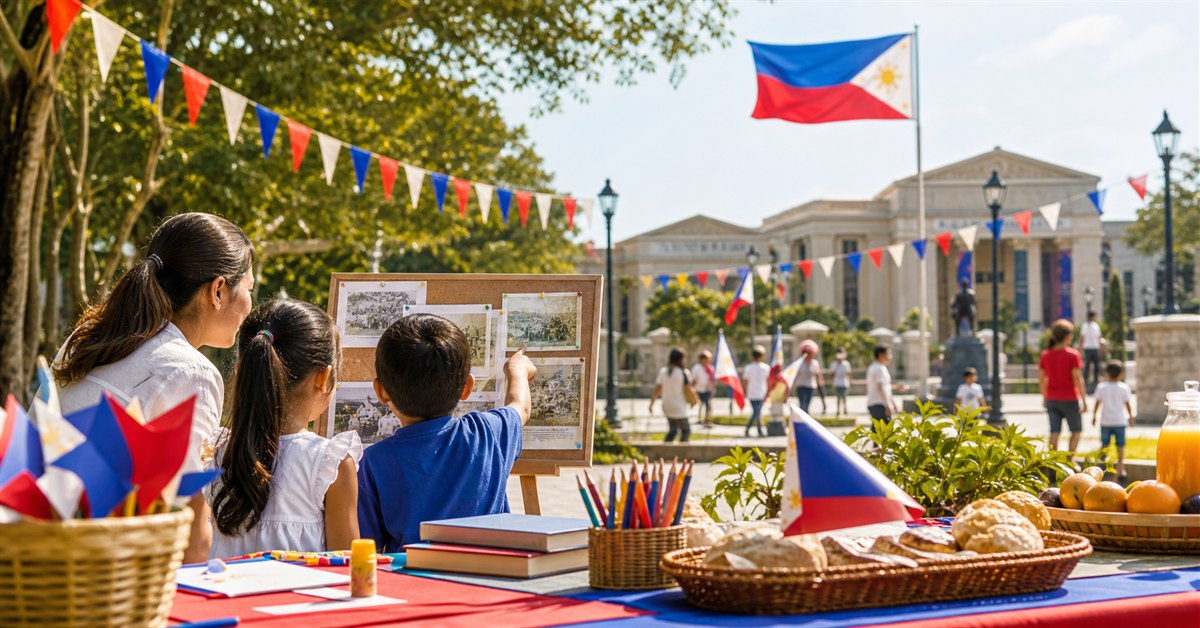
Independence Day activities work best when they connect the national story to family, school, food, language, and everyday Filipino life.
Table of contents
- Quick facts for June 12, 2026
- Easy activities for families
- Activities for kids and students
- Activities for offices and community groups
- Fun facts about Philippine Independence Day
- Flag etiquette reminders
- Food ideas for June 12
- Where to go
- Sources and notes
- FAQs
Quick facts for June 12, 2026
| Question | Answer |
|---|---|
| What date is Philippine Independence Day 2026? | Friday, June 12, 2026 |
| Is it a public holiday? | Yes, June 12 is a regular national holiday |
| What does it commemorate? | The June 12, 1898 proclamation of Philippine independence in Kawit, Cavite |
| Who proclaimed independence? | Emilio Aguinaldo |
| What important symbols appeared that day? | The Philippine flag was unfurled and the anthem melody was played |
| Why not July 4? | The Philippines later restored June 12 as Independence Day to emphasize the Filipino declaration of 1898 |
| What is the Filipino name? | Araw ng Kalayaan |
Easy activities for families
1. Display the Philippine flag properly
The simplest activity is also one of the most meaningful. If your family has a Philippine flag, check that it is clean, displayed respectfully, and positioned correctly. In peacetime, the blue field is above the red field when the flag is horizontal. If the flag is vertical, the blue field should be to the observer’s left.
This is a good moment to teach kids that the flag is not just decoration. It represents history, sacrifice, and national identity. You can turn it into a quick family activity by asking what each color and symbol might mean before looking up the official explanation.
2. Attend a flag-raising ceremony
Many city halls, municipal halls, schools, barangays, malls, museums, and community groups hold Independence Day flag ceremonies. You do not need to attend the biggest national event. A local ceremony can be more meaningful because it shows how the holiday is observed where your family actually lives.
If you bring kids, explain the order before arriving: standing respectfully, singing the national anthem, listening to short remarks, and avoiding unnecessary noise during the ceremony.
3. Visit a monument, plaza, or historical marker
Most families cannot go to Kawit every year, but many towns and cities have monuments, markers, old municipal halls, churches, plazas, or museums connected to local history. A short walk can become an Independence Day activity if you ask: “What happened here?” and “Whose names do we pass every day without noticing?”
For a low-cost plan, choose one historical place nearby, read about it before going, take a family photo, and talk about why it matters.
4. Cook a Filipino meal and tell a story
Food is one of the easiest ways to make a holiday feel real. You can cook adobo, sinigang, pancit, kare-kare, grilled fish, lumpia, kakanin, or whatever food your family associates with home.
The activity is not just eating. Ask older family members to tell a story: where they grew up, what language they spoke at home, what local festivals they remember, what school taught them about June 12, or what they think “kalayaan” means now.
5. Watch or read something short together
Not every family wants a full-day outing. A short documentary, a reliable history article, a museum page, or a school-friendly explainer can be enough. Keep it short if kids are young. Afterward, ask each person for one fact they learned and one question they still have.
Activities for kids and students
Paper flag craft
Let kids make small flags using paper, crayons, glue, and safe sticks. The point is not perfection. The point is learning the parts: triangle, sun, stars, blue, red, and white. After the craft, ask them to explain one symbol in their own words.
Three-stars map activity
The three stars on the Philippine flag are commonly taught as representing Luzon, Visayas, and Mindanao. Give kids a blank map and let them label the three major island groups. This turns a flag lesson into geography.
“Ask Lolo or Lola” interview
Prepare three simple questions:
- What did Independence Day mean when you were in school?
- What Filipino tradition do you want us to remember?
- What does freedom mean in everyday life?
Record the answers in a notebook. This makes history personal and gives children a family memory, not just a textbook fact.
Mini quiz
Use questions that are easy enough for kids but useful for adults:
- What date is Independence Day?
- Where was independence proclaimed in 1898?
- Who proclaimed independence?
- What song melody was first played that day?
- What are the main colors of the Philippine flag?
- What do the three stars represent?
- Why is June 12 important?
Keep the tone fun. The goal is curiosity, not embarrassment.
Local hero spotlight
Instead of only naming national heroes, ask students to research a local hero, historical figure, artist, writer, teacher, or community leader from their province or city. Independence Day becomes more meaningful when kids see that history did not happen only in Manila or Cavite.
Activities for offices and community groups
Short flag ceremony and reflection
For offices, schools, and civic groups, a short ceremony can be enough. Keep the program respectful and concise: flag, anthem, short remarks, and a reflection prompt. Avoid turning the day into a generic corporate event.
Filipino culture potluck
Ask people to bring food from their province or family tradition. The discussion can be simple: what is the dish, where is it from, and when does your family cook it? This works especially well for teams with members from different regions.
Local makers or Filipino-made product corner
If the group wants a practical activity, feature Filipino-made goods, local books, crafts, food products, clothing, or small businesses. This connects independence with everyday support for Filipino work and creativity.
History wall
Create a small display with printed facts, maps, old photos, or short biographies. Keep the text readable and brief. A good display invites people to stop for one minute, learn one fact, and continue with their day.
Fun facts about Philippine Independence Day
1. The 1898 proclamation happened in Kawit, Cavite
The central event happened at the home of Emilio Aguinaldo in Kawit, Cavite. Today, the site is known as the Aguinaldo Shrine, a major historical place associated with the proclamation.
2. The flag was unfurled during the proclamation
The Philippine flag is deeply tied to June 12 because it was displayed during the independence proclamation. This is why flag display and flag etiquette are such important parts of the holiday.
3. The anthem melody was first played there
The music that became associated with the Philippine national anthem was played during the 1898 proclamation. The lyrics and official rules developed later, but the musical moment is part of the June 12 story.
4. June 12 was not always the official Independence Day
For years, July 4 was used because it marked the date in 1946 when the United States recognized Philippine independence. In 1962, President Diosdado Macapagal moved the observance to June 12, and Republic Act 4166 later made June 12 the official Independence Day.
5. May 28 to June 12 is connected to flag observance
Under Philippine flag practice, the period from May 28 to June 12 is associated with National Flag Days. This is why you may see more flags displayed in the weeks leading up to Independence Day.
6. The holiday can be solemn and festive at the same time
Independence Day includes ceremonies, wreath-laying, speeches, and historical reflection. It can also include food, family gatherings, cultural programs, parades, and school activities. Both sides matter.
7. The date carries a debate that is worth understanding
June 12 emphasizes the Filipino declaration of independence in 1898. July 4, 1946 marks international recognition of Philippine independence after the American colonial period. Understanding both dates helps students see that history is layered, not a simple single-day story.
8. The flag position has meaning
In peacetime, blue is placed above red. The red field is placed above blue when the country is at war. This is one of the most memorable flag facts for students because the change is visual and symbolic.
9. Independence Day is not only for history classes
The holiday also connects to language, food, music, local craftsmanship, community service, civic responsibility, and family memory. That is why simple home activities can still be meaningful.
10. A small local visit can be better than a crowded event
Not every family needs to attend a major ceremony. Visiting a nearby historical marker, municipal plaza, old church, museum, or monument can create a calmer and more personal Independence Day experience.
Flag etiquette reminders
The Philippine flag should be treated respectfully. Do not use it as a tablecloth, costume, wrapper, floor decoration, or casual party prop. If you make paper flags for children, explain that the official flag itself has rules and should not be treated like disposable decoration.
For home display, keep the flag clean and secure. Avoid letting it touch the ground. If it is old and faded, replace it with a proper flag instead of using a damaged one for display.
Food ideas for June 12
Food does not need to be historically exact. Choose dishes that make your family feel connected to place and memory:
- Adobo for a familiar family meal
- Pancit for sharing
- Kakanin for merienda
- Lumpia for gatherings
- Sinigang or nilaga for home comfort
- Grilled fish or pork for a simple lunch
- Buko juice, calamansi juice, or sago’t gulaman
- Regional dishes from your province
The activity can be as simple as asking: “What dish reminds you of home?” That question can open better conversations than a formal lecture.
Where to go
Aguinaldo Shrine in Kawit, Cavite
This is the most direct historical site for the June 12 proclamation. Expect higher attention around Independence Day. Check visitor information before going because hours and event access can change.
National Museum sites
National Museum locations can be good for families who want a cultural and historical activity without making the day too heavy. Choose a museum section that fits the age of the children.
Local museums and city halls
City halls, municipal halls, schools, local museums, and plazas often hold Independence Day programs. These are useful if you want a meaningful activity close to home.
Monuments and historical markers
If a formal museum trip is not possible, visit a nearby monument or marker. Read the plaque. Look up the person or event. Take one family photo and talk about why the place is there.
Sources and notes
- The Official Gazette holiday page is used for the 2026 regular holiday context.
- Republic Act No. 4166 is used for the legal shift establishing June 12 as Philippine Independence Day.
- The National Historical Commission of the Philippines Aguinaldo Shrine page is used for the Kawit, Cavite historical-site context.
- Republic Act No. 8491 is used for flag and heraldic-code context.
- The existing TheBudolFinds pillar page, Philippine Independence Day, provides the fuller background history.
FAQs
When is Philippine Independence Day 2026?
Philippine Independence Day 2026 is on Friday, June 12, 2026. June 12 is observed every year as a regular national holiday in the Philippines.
What can families do on Philippine Independence Day?
Families can display the Philippine flag correctly, attend a flag ceremony, visit a museum or historic site, cook Filipino food, hold a history quiz, watch documentaries, talk about family stories, or support local Filipino-made products.
What are good Independence Day activities for kids?
Good kid-friendly activities include making paper flags, learning the meaning of the sun and stars, coloring a map of the Philippines, visiting a museum, reading a short story about heroes, or asking grandparents what freedom means to them.
What are fun facts about Philippine Independence Day?
The June 12, 1898 proclamation happened in Kawit, Cavite; the Philippine flag was unfurled there; the anthem melody was first played there; and June 12 became the official Independence Day after President Diosdado Macapagal’s 1962 proclamation and Republic Act 4166.
Do Filipinos work on Independence Day?
June 12 is a regular national holiday, so government offices, schools, and many banks are closed. Private-sector work schedules and holiday pay follow labor rules and employer arrangements.
Why is Philippine Independence Day on June 12?
June 12 marks the 1898 proclamation of Philippine independence from Spain in Kawit, Cavite. The date was restored as the official Independence Day in the 1960s to emphasize a Filipino declaration of sovereignty.
Final thought
Philippine Independence Day 2026 does not need to be complicated. A respectful flag display, a family meal, a museum stop, a local history walk, or a conversation with grandparents can make June 12 meaningful. The best activity is the one that helps someone understand that freedom is not only a date in a textbook, but a responsibility carried into daily Filipino life.