
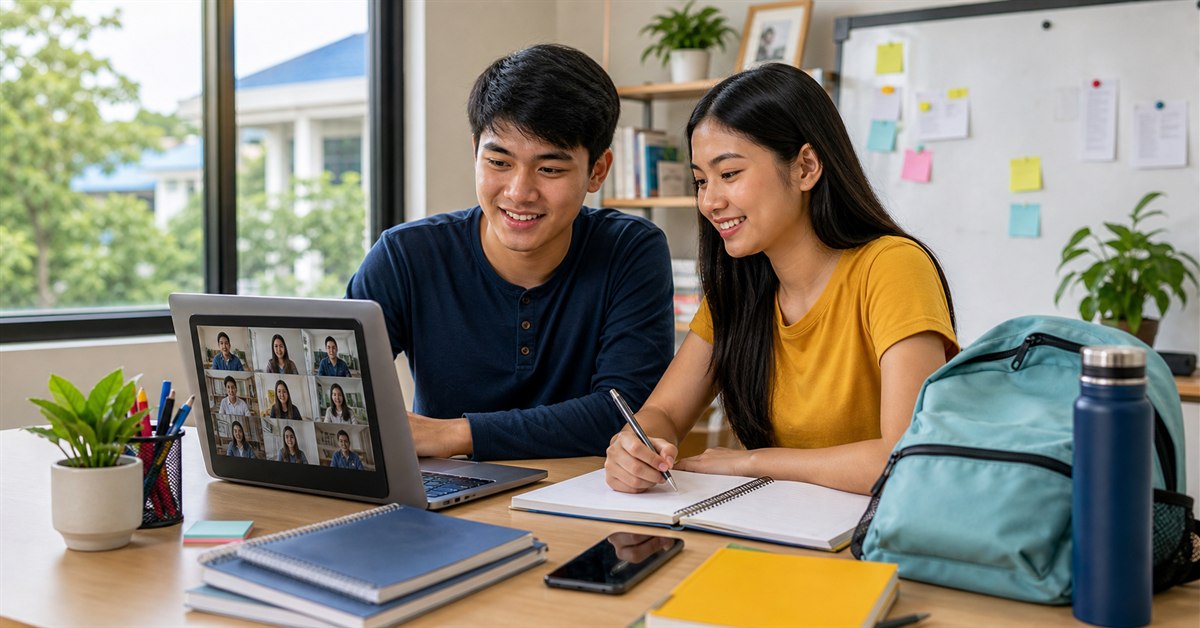
Filipino students are choosing hybrid learning in 2026 because school is no longer just a classroom question. It is also a commute question, a fuel and electricity question, an internet question, a family-budget question, and a time-management question. Hybrid learning offers a middle path: students still get face-to-face instruction, but some lectures, activities, submissions, consultations, and review work move online.
That does not mean hybrid is automatically better than full face-to-face classes. It works well for some students and badly for others. The main reason it keeps gaining attention in the Philippines is practical: students, parents, and schools are trying to keep learning moving despite traffic, energy pressure, classroom congestion, weather disruption, and uneven access to technology.
This is also why students are investing differently in school basics. A hybrid setup rewards reliable devices, stable charging, better study routines, and a home space that can handle online work. For practical gear planning, see our laptops under P20,000 guide, tablets under P10,000 guide, power banks under P1,000 guide, and college student essentials guide.
Quick answer: the main reasons
| Reason | Why it matters to students |
|---|---|
| Commute savings | Fewer travel days can mean less fare, less traffic, and more study or rest time |
| Energy and operating costs | Schools and families respond to electricity, fuel, and transport pressure |
| Weather disruption | Typhoons, floods, heat, and class suspensions make continuity important |
| Classroom congestion | Online days can reduce pressure on crowded rooms and facilities |
| Work-study schedules | College and senior high students can balance part-time work, family duties, and study |
| Digital study habits | LMS, group chats, cloud docs, recordings, and AI tools are already part of student life |
| Better use of campus time | In-person days can focus on labs, presentations, exams, and mentoring |
| Still needs social learning | Students do not want isolation; hybrid keeps some face-to-face contact |
Hybrid learning is not a shortcut. It is a schedule design. When the design is clear, students get flexibility without losing structure. When the design is messy, students get the worst of both worlds: too many online tasks and not enough guidance.
1. Energy and transport costs made flexibility normal again
Hybrid learning got renewed attention in 2026 because the education system had to respond to wider cost pressure. GMA News reported on April 8, 2026 that CHED permitted higher education institutions to shift up to 100% online delivery as a temporary arrangement during the national energy emergency, subject to institutional capacity and student readiness. The next day, GMA also reported that DepEd allowed private schools to shift to blended learning to help manage rising electricity costs, with specific remote-learning limits by grade level.
For students, the policy discussion becomes personal very quickly. A class day is not just tuition. It can include jeepney, tricycle, bus, MRT, UV, gas, food, printing, and time lost in traffic. If a student can attend two lecture days online and reserve campus days for lab, exams, group work, or consultations, the week feels more manageable.
That is why many students do not see hybrid as a pandemic throwback. They see it as a budget and time tool. The question is no longer "Can we learn online?" It is "Which parts of school truly need campus time, and which parts can be done remotely without hurting learning?"
2. Classroom congestion is pushing schools to test new schedules
Hybrid learning also fits a practical school-capacity problem. GMA News reported in March 2026 that DepEd was considering a "4+1" blended learning model, with four days of in-person classes and one day of online learning, as one possible response to classroom congestion.
Students feel congestion in daily life: packed rooms, hot classrooms, limited chairs, short lab time, noisy corridors, and difficulty finding space for group work. Hybrid days can reduce pressure on buildings if the school designs them well.
The important part is "if." A hybrid day cannot simply become a pile of modules. Students need scheduled online sessions, clear deadlines, teacher feedback, and realistic workload. If the remote day is treated as an assignment dump, students will not see it as flexible. They will see it as unpaid overtime.
3. Students want fewer wasted hours
The strongest student argument for hybrid learning is time. A student commuting across Metro Manila or from a nearby province can lose hours before the first class even starts. Students in the provinces may travel through multiple rides, wait for scarce transport, or deal with flooded roads during rainy season.
Hybrid learning gives those students a chance to use some of that time for:
- Recorded lecture review.
- Reading and note-making.
- Group work through calls or shared documents.
- Part-time work.
- Family responsibilities.
- Rest and recovery.
- Commuting only when campus presence matters.
This does not mean students want to stay home forever. Many still prefer face-to-face classes for hard subjects, labs, performance tasks, and social life. What they want is a schedule that respects time instead of measuring seriousness by how many days they physically sit in a room.
4. Digital habits are already part of school
Even in face-to-face classes, students already use digital tools: group chats, LMS portals, Google Docs, Canva, online quizzes, recorded explanations, e-books, AI writing support, and video calls. Hybrid learning formalizes what is already happening informally.
The Philippine Statistics Authority's 2024 FLEMMS report says four out of five Filipinos aged 10 to 64 used the internet for social media. That figure is not the same as saying every student has reliable school internet, but it shows why digital communication is already embedded in daily life. The gap is no longer whether students are online at all. The real gap is whether they have the right device, stable connection, quiet space, and digital study skills for learning.
DICT's Free Wi-Fi for All program also points to the government's recognition that internet access is now part of public service. The program reported 17,966 activated Free Wi-Fi for All sites as of March 31, 2025, and PNA reported DICT's 2025 commitment to connect nearly 12,000 unserved public schools in geographically isolated and disadvantaged areas.
Hybrid learning grows faster when connectivity improves, but connectivity is still uneven. A student with a laptop, fiber internet, and a quiet room is not having the same experience as a student sharing one phone with siblings on prepaid data.
5. Hybrid learning supports working students
Many college students and senior high students carry responsibilities outside school. Some work part-time, help in family businesses, care for younger siblings, commute long distances, or split time between two households.
Hybrid learning helps when:
- Lectures are recorded or documented.
- Some consultations happen online.
- Submissions are digital.
- Group meetings can happen after school hours.
- Campus days are planned around high-value activities.
This is especially useful for students in review classes, board exam preparation, thesis work, internships, and skills-based programs where not every activity needs a classroom. A lecture can move online. A lab, demo, performance, clinical skill, shop activity, or practicum usually still needs supervised face-to-face time.
That balance is why hybrid learning is more realistic than fully online learning for many programs.
6. Weather and class suspensions make continuity valuable
The Philippines does not have a calm school calendar. Typhoons, floods, heat, transport strikes, earthquakes, volcanic activity, and local emergencies can interrupt classes. Hybrid learning gives schools a continuity option when travel is unsafe but learning can still continue.
This is not an argument for forcing students online during every emergency. If power is out, internet is down, or families are evacuating, schoolwork should not be the priority. But when disruption is milder or localized, hybrid systems help teachers communicate, adjust deadlines, share materials, and keep students from falling too far behind.
For families, this means school prep now includes more than uniforms and notebooks. It includes charging devices, keeping a power bank ready, saving LMS passwords, and knowing how the school announces remote classes. Our family typhoon preparedness guide covers the emergency side of that routine.
7. Students still need face-to-face learning
Hybrid learning is not a vote against teachers or classrooms. In many cases, students choose hybrid because they want the useful parts of both formats.
Face-to-face classes are still better for:
- Labs and hands-on subjects.
- Performance tasks.
- Oral recitation and discussion.
- Mentoring and emotional support.
- Fast feedback.
- Social learning.
- Campus facilities.
- Students who struggle with self-discipline at home.
Online days are better for:
- Lecture review.
- Reading-heavy tasks.
- Drafting papers and reports.
- Short consultations.
- Some quizzes and submissions.
- Group coordination.
- Recorded explanations.
Current research supports this nuance. A 2026 Research and Practice in Technology Enhanced Learning study on high-school online learning experiences in the Philippines looked at how classroom experience, environment, and engagement connect in synchronous online platforms. Other 2026 studies on digital learning platforms and student engagement similarly point to the importance of instructional design, teacher competence, interaction, and LMS convenience. In plain terms: the platform does not teach by itself. The class design still matters.
8. The biggest risk is inequality
Hybrid learning can help students, but it can also expose inequality. The students who benefit most often have reliable internet, their own device, a quiet place to study, and parents or guardians who understand the setup. Students without those supports can fall behind quietly.
Common problems include:
- One phone shared by siblings.
- Prepaid data running out during class.
- Weak signal inside the home.
- No quiet study space.
- Parents assuming online class means "free time."
- Teachers assigning too much asynchronous work.
- Unclear deadlines across different platforms.
- Students multitasking during video calls.
- Cheating and AI misuse concerns.
- Courses that need equipment or supervised practice.
This is why hybrid learning should not be treated as a cheap substitute for school buildings, teachers, libraries, labs, and student support. It should be a flexible layer on top of a serious education system.
What a good hybrid class looks like
Students are more likely to choose hybrid learning when the school does the basics well:
- The weekly schedule is predictable.
- Online and in-person tasks are clearly different.
- Teachers do not duplicate workload across both modes.
- The LMS is organized by week or module.
- Deadlines are visible in one place.
- Recordings or summaries are available when reasonable.
- In-person days are used for interaction, feedback, labs, exams, and mentoring.
- Online days are used for reading, review, drafting, and guided independent work.
- Students know where to ask questions.
- Connectivity problems have a fair reporting process.
The worst version is "hybrid in name only": students commute most days, then still receive heavy online work at night. That setup feels flexible for the institution but exhausting for students.
What students and families should prepare
Hybrid learning does not require the most expensive setup. It requires reliability.
Basic student setup:
- A phone that can handle school apps and group chats.
- A laptop or tablet for longer work if the budget allows.
- Stable internet or a backup data plan.
- Earphones with a working microphone.
- Power bank.
- Notebook for offline planning.
- Folder for printed modules or handouts.
- Calendar app or planner.
- A consistent study corner.
For device planning, students can start with our budget laptops under P20,000 or budget tablets under P10,000 guides. The better question is not "What is the fanciest device?" It is "Can this device handle video calls, documents, research, LMS access, and battery needs for the whole semester?"
Will hybrid learning stay after 2026?
Hybrid learning will likely stay, but not as a single national default for every student. The more realistic future is selective hybrid learning:
- Colleges using online days for lecture-heavy subjects.
- Private schools using blended days during cost or energy pressure.
- Review centers offering online and face-to-face schedules.
- Schools shifting temporarily during weather disruption.
- Teachers using LMS tools even in face-to-face classes.
- Programs keeping hands-on requirements on campus.
Students are not choosing hybrid because they want less school. They are choosing it because they want school to fit the real constraints of 2026: traffic, cost, weather, digital life, family duties, and the need for both flexibility and human support.
Source note
This analysis uses current education reporting from GMA News on CHED's April 8, 2026 online-class flexibility and DepEd's April 9, 2026 blended-learning flexibility for private schools, GMA's March 2026 report on DepEd's proposed 4+1 blended model for classroom congestion, PSA's 2024 FLEMMS internet-use context, DICT Free Wi-Fi for All program data, and 2026 research on online learning engagement among Filipino students. Policy details can change by school level and institution, so students should follow their own school, DepEd, CHED, and local government advisories.
FAQ
Why are Filipino students choosing hybrid learning in 2026?
Filipino students are choosing hybrid learning because it can reduce commute time and costs, help during energy or weather disruptions, fit work-study schedules, reduce classroom crowding, and let students use online tools without losing all face-to-face interaction.
Is hybrid learning the same as online learning?
No. Hybrid learning combines in-person classes with online or remote work. Fully online learning happens entirely through digital platforms, while hybrid learning keeps some classroom time for discussion, labs, exams, or activities that need teacher supervision.
Is hybrid learning allowed in the Philippines in 2026?
Policies vary by level and school type. In 2026, CHED allowed higher education institutions temporary flexibility to shift up to 100% online during the energy emergency, while DepEd allowed private schools to adopt blended learning under specific conditions.
Do students learn better in hybrid classes?
It depends on design. Hybrid classes work better when schedules are clear, teachers coordinate online and in-person tasks, the LMS is easy to use, and students have reliable internet, devices, quiet study time, and feedback.
What are the biggest problems with hybrid learning?
The biggest problems are weak internet, shared devices, noisy homes, poor time management, unclear deadlines, weak teacher training, too many online tasks, cheating concerns, and courses that need hands-on practice.
Why do some students prefer face-to-face classes?
Some students prefer face-to-face classes because it is easier to ask questions, stay motivated, use school facilities, work with classmates, and separate school life from home responsibilities.
What devices do students need for hybrid learning?
A reliable phone can handle basic communication, but a laptop or tablet is better for documents, research, video calls, presentations, and long writing tasks. A power bank and stable internet backup also help.
Will hybrid learning stay after 2026?
Hybrid learning will likely remain as a selective option, especially for higher education, private schools, review classes, weather disruption, and courses that can separate lecture time from hands-on activities.