
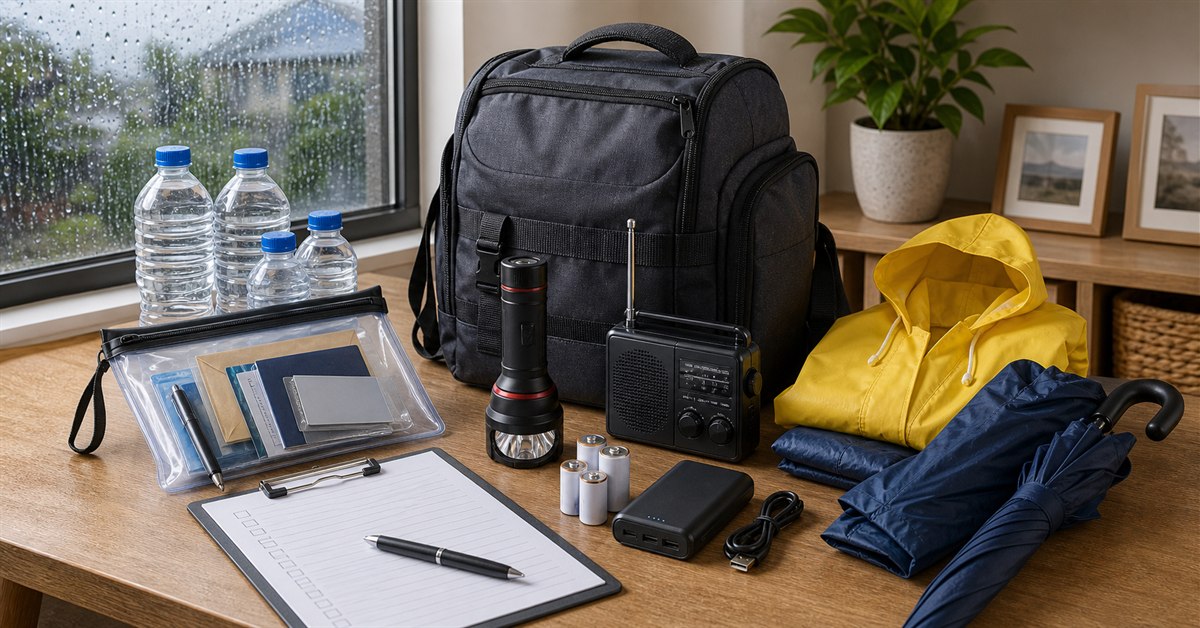
Filipino families prepare for typhoon season best when they treat it as a household routine, not a last-minute panic. The practical goal is simple: everyone knows where to get alerts, what to pack, who is responsible for each person, where to evacuate, and what to check after the storm. A prepared home does not need expensive gear first. It needs a working plan, reachable family members, protected documents, safe water, basic food, charged lights and phones, and the discipline to move early when local officials say to evacuate.
This guide is for ordinary Filipino households: parents with school-age kids, extended families with grandparents, renters in flood-prone streets, condo residents who lose power, and families who split time between work, school, and home. Use it together with our rainy season essentials Philippines guide, best raincoats Philippines guide, waterproof bags guide, and power banks under P1,000 guide.
Quick family checklist
| What to prepare | Why it matters | Family owner |
|---|---|---|
| Alert sources | Avoid rumors and late decisions | One adult checks PAGASA, LGU, and barangay updates |
| Go bags | Lets the family leave fast if evacuation is needed | One bag owner per adult |
| Documents pouch | Protects IDs, school records, prescriptions, and cash | One adult keeps copies updated |
| Water and food | Covers interruptions in supply and stores | One adult tracks expiry dates |
| Medicines | Supports seniors, kids, and chronic conditions | Medicine owner checks monthly |
| Power and lights | Keeps phones, flashlights, radios, and lamps working | Teen or adult charges devices |
| Rain gear | Reduces floodwater exposure and soaked commutes | Each person checks fit |
| Evacuation plan | Prevents arguing when time is short | Whole family reviews route |
| Post-flood health checks | Catches risks after the water recedes | Adult checks wounds, symptoms, and food safety |
If your family only has one hour today, do three things: save official alert links, put documents in a waterproof pouch, and build a basic go bag. Everything else can be improved over the week.
Start with the warnings, not the shopping list
The first typhoon-season habit is checking reliable warnings. PAGASA explains that the Tropical Cyclone Wind Signal system uses five levels, with higher signals tied to stronger wind threats and shorter warning lead times. Its TCWS explainer also notes that local winds can be stronger in exposed coastal, upland, or mountainous areas.
For families, that means a wind signal is not just trivia. It should trigger household actions:
- Signal No. 1: check the go bag, charge power banks, refill water, and secure lightweight items outside.
- Signal No. 2: expect stronger disruption; review evacuation routes, move important items higher, and keep kids and seniors near home.
- Signal No. 3 and above: treat travel as risky, listen closely to LGU evacuation guidance, and do not delay moving from flood-prone, coastal, riverside, or landslide-prone areas.
Typhoon decisions should combine PAGASA alerts with local guidance. Your barangay, city, or municipality knows which streets flood first, which bridges close, which schools become evacuation centers, and which areas have landslide or storm-surge risk. Save the official Facebook page, hotline, and alert channel of your LGU before typhoon season starts.
Do not rely on forwarded screenshots alone. If a message looks urgent, verify it against PAGASA, your LGU, or your barangay. Typhoon misinformation spreads fast because people are scared and tired. A family plan should include one person responsible for checking primary sources before the household acts on viral updates.
Make a family communication plan
In many Filipino homes, the family is not in one place when heavy rain starts. One parent may be at work, one student may still be in school, one sibling may be commuting, and grandparents may be at home. The plan has to work even when mobile data is weak.
Write down:
- Each family member's full name, phone number, school or work address, and usual route.
- Two emergency contacts outside the immediate household.
- The barangay, city, and nearby evacuation center contact points.
- A preferred meeting place near home.
- A backup meeting place outside the flood-prone area.
- Who picks up children if classes are suspended.
- Who checks on seniors, persons with disability, pets, and neighbors who may need help.
Put this list in the go bag and save a copy on every phone. For younger children, place a small card in the school bag with parent names, contact numbers, blood type if known, allergies, and an alternate guardian. For seniors, keep a medicine list, diagnosis notes, and doctor contact details in the document pouch.
Families should also agree on a simple rule: when warnings escalate, everyone sends a short status update. It can be as basic as "home," "school," "work," "commuting," or "with tita." The point is to reduce confusion before the signal gets stronger.
Build the go bag around real evacuation needs
A go bag is not a camping hobby. It is a grab-and-leave bag for evacuation, sudden flooding, power interruption, or being stranded away from normal supplies. Quezon City describes an emergency go bag as essential supplies that can be quickly grabbed during emergencies, including food, water, medicines, and important documents.
Start with one backpack or duffel that an adult can actually carry. If you overload it, nobody will bring it. A practical family setup is one main household bag plus smaller personal pouches.
Basic go bag contents
- Drinking water or refillable bottles.
- Ready-to-eat food that your family will actually eat.
- Flashlight or headlamp.
- Extra batteries or rechargeable lamp.
- Power bank and charging cable.
- Battery radio if you have one.
- Whistle.
- Basic first aid kit.
- Maintenance medicines and prescriptions.
- Face masks.
- Alcohol or hand sanitizer.
- Tissue, wet wipes, sanitary pads, diapers, or adult hygiene supplies as needed.
- Lightweight clothes and underwear.
- Raincoat or poncho.
- Small towel.
- Important documents in a waterproof pouch.
- Cash in small bills and coins.
- Pen and small notebook.
- House keys and spare keys.
The Philippine Red Cross advised the public in its 2025 rainy-season readiness update to organize a personal go bag with supplies such as food, water, emergency tools, medicines, clothes, money, and important documents for possible evacuation. Its broader 4Ps reminder is also useful for families: predict, plan, prepare, and practice.
Do not wait until a typhoon is forecast before building this bag. Stores run out, delivery slows down, and everyone becomes busy at the same time. Build the first version now, then improve it after payday or grocery day.
Protect documents, cash, and phone access
After a flood, documents become one of the hardest things to replace. Filipino families should protect documents before the water rises, not after someone is already carrying bags out of the house.
Prepare a waterproof pouch with:
- Government IDs.
- Birth certificates and marriage documents.
- PhilHealth, HMO, or insurance cards.
- Prescriptions and medical summaries.
- School IDs and school records.
- Land title, lease, mortgage, or utility account copies when relevant.
- Vaccination records for children and pets.
- Emergency contacts.
- ATM cards and small cash.
You do not need to put every original document in the bag if that creates risk. A good setup is waterproof photocopies in the go bag, digital copies in secure cloud storage, and originals stored high in a sealed container. Take photos of key documents and make sure at least two adults can access them.
Cash matters because card payments, QR payments, and ATMs may fail during power or network interruptions. Keep small bills because evacuation centers, sari-sari stores, and transport options may not have change.
Prepare water, food, and cooking limits
Water is more urgent than food during disruption. Store drinking water before a storm arrives. If you use water containers, clean them and label the refill date. If your area often loses water service, store extra for hygiene and toilet flushing too.
For food, choose items that do not require complicated cooking:
- Canned goods with an easy-open option or can opener.
- Crackers, biscuits, and bread.
- Ready-to-eat meals.
- Peanut butter or spread.
- Instant oatmeal or cereal.
- Powdered milk or shelf-stable milk.
- Baby food if needed.
- Pet food if needed.
Think through your cooking setup honestly. If your home uses electric appliances and power is out, can you cook? If you use LPG, is the tank safe and accessible? If the area floods, cooking may not be practical at all. That is why ready-to-eat food belongs in the go bag.
Check expiry dates every few months. Rotate food into normal meals before it expires, then replace it. A go bag should not become a museum of stale biscuits and dead batteries.
Keep power and communication working
Power loss changes everything. Phones become the family alert system, flashlight, bank, map, camera, and contact book. Before a storm:
- Fully charge all phones.
- Charge power banks.
- Charge rechargeable lamps and flashlights.
- Check battery radios.
- Save emergency hotlines offline.
- Download or screenshot route maps.
- Turn on low power mode early.
- Keep one charging cable per phone type.
If you need gear, use our best power banks Philippines under P1,000 guide and best rechargeable flashlight Philippines guide. For typhoon prep, reliability matters more than fancy features. A plain flashlight that turns on is better than a feature-packed gadget that nobody charged.
Families in condo units or apartments should also check building rules: generator coverage, elevator shutdown plans, water pump dependency, parking flood risk, and lobby communication procedures. A high-rise home can still have a typhoon problem if the elevator, water pump, or mobile signal fails.
Secure the home before winds and rain get worse
Do the physical home checks while it is still safe to move around. Strong wind and heavy rain make small tasks dangerous.
Before the storm:
- Clear balcony, yard, and roof-deck items that can fly.
- Move plants, chairs, laundry racks, and lightweight tools indoors.
- Check windows, screens, and doors.
- Move electronics, documents, school bags, and shoes higher.
- Unplug appliances if flooding is possible.
- Clear nearby drains if safe and allowed.
- Fill clean water containers.
- Park vehicles away from low-lying or tree-heavy areas if possible.
- Check pet carriers and leashes.
If your area floods, mark a "move higher" line at home. When water reaches a certain step, doorway, canal level, or street marker, the family stops debating and starts moving valuables or evacuating. Pre-deciding that threshold is easier than arguing while the water is already rising.
For personal rain gear, see our best umbrellas for rainy season guide, best waterproof shoes guide, and best waterproof bags Philippines guide. The safest plan is still to avoid floodwater when possible, but practical gear helps when evacuation or commuting cannot be avoided.
Plan around children, seniors, PWDs, and pets
Typhoon prep gets more serious when a household includes people who cannot simply walk out carrying a bag. Assign responsibility before the emergency.
For children:
- Pack comfort items, snacks, milk, diapers, school ID, and medicine.
- Teach them the family meeting point.
- Put contact cards in their bags.
- Explain evacuation in calm language before a storm arrives.
For seniors:
- Prepare medicine for several days.
- Keep prescriptions and medical notes in the document pouch.
- Pack eyeglasses, dentures, hearing aids, batteries, cane, walker, or wheelchair needs.
- Assign one adult to assist them during evacuation.
For persons with disability:
- Check mobility routes before flooding.
- Keep assistive devices close.
- Prepare written instructions for medicines or devices.
- Coordinate with barangay or building management if evacuation help may be needed.
For pets:
- Prepare food, water, leash, carrier, vaccination records, and waste bags.
- Check whether the evacuation center accepts pets or where pets can safely stay.
- Do not leave tied animals in areas that can flood.
The family plan should name specific people, not vague promises. "Kuya handles lola's medicine pouch" works better than "someone should bring lola's things."
Know when to evacuate
Evacuation is easier early and harder late. If the local government, barangay, or rescue team advises evacuation, treat it seriously. Families in flood-prone streets, near rivers, near coastlines, below slopes, or in light-material homes should be especially conservative.
Evacuate early when:
- Floodwater is rising faster than usual.
- The barangay announces preemptive evacuation.
- You are near a river, creek, coast, or landslide-prone slope.
- The home has weak roofing, walls, or electrical safety concerns.
- Children, seniors, pregnant family members, PWDs, or sick family members need extra time.
- Nightfall is close and the weather is worsening.
Do not wait for chest-deep water. Do not drive into moving floodwater. Do not cross flooded bridges or roads just because other people are trying it. During a typhoon, the bravest decision is often the early, boring one: leave while the route is still passable.
Families should pre-check likely evacuation centers, but always follow current LGU instructions because centers may change depending on the hazard and capacity.
After the typhoon: inspect slowly
The danger does not end when the rain stops. Post-typhoon injuries and illnesses often happen during cleanup.
Before entering or cleaning:
- Check for downed wires and electrical hazards.
- Do not switch on outlets or appliances that got wet.
- Check ceiling, walls, stairs, and posts for damage.
- Throw away food touched by floodwater.
- Boil or treat water if advised by authorities.
- Wash hands often.
- Clean wounds immediately.
- Avoid wading in floodwater unless absolutely necessary.
- Wear boots and gloves during cleanup if available.
Health risk matters. A Philippine News Agency report on DOH guidance warned about leptospirosis risk during rainy season and flood exposure, especially when contaminated water enters through cuts, eyes, nose, or mouth. Seek medical advice after flood exposure if someone develops fever, calf or lower-back muscle pain, red eyes, chills, vomiting, diarrhea, yellowing skin, dark urine, or other worrying symptoms.
Also watch for dengue risks after rain. Empty containers, old tires, buckets, plant saucers, and roof gutters can collect water. Cleaning after a storm is not only about mud. It is also about removing mosquito breeding spots and keeping stored water covered.
A realistic seven-day prep plan
If your family is starting from zero, do not try to become perfectly prepared in one night. Use a one-week plan.
| Day | Task |
|---|---|
| Day 1 | Save PAGASA, LGU, barangay, school, and work alert sources |
| Day 2 | Create family contact cards and meeting points |
| Day 3 | Put documents, IDs, prescriptions, and cash in a waterproof pouch |
| Day 4 | Build the first go bag with water, food, flashlight, medicine, hygiene, and clothes |
| Day 5 | Charge and test flashlights, lamps, radios, and power banks |
| Day 6 | Check home risks: drains, balcony items, windows, parking, and high storage |
| Day 7 | Review evacuation roles for kids, seniors, PWDs, and pets |
Preparedness is not a single shopping trip. It is a family habit that gets better each rainy season.
Source note
This guide follows official and public-service preparedness guidance from PAGASA's Tropical Cyclone Wind Signal explainer, Quezon City's emergency go bag guide, Philippine Red Cross rainy-season guidance on go bags and the 4Ps in disaster management, and DOH leptospirosis precautions reported by the Philippine News Agency. Local conditions vary, so follow your barangay, city, municipality, school, workplace, and rescue authorities during an active storm.
FAQ
What should Filipino families prepare before typhoon season?
Prepare a family contact plan, emergency go bags, copies of important documents, drinking water, ready-to-eat food, medicines, flashlights, batteries, a charged power bank, rain gear, basic tools, and an evacuation plan tied to your barangay or local government advisories.
How many days should a family go bag cover?
Many preparedness guides use a 72-hour or three-day target. Filipino families can start with one grab bag per adult, then add shared household supplies for water, food, hygiene, medicine, baby needs, senior needs, and pet needs. If carrying three days of supplies is too heavy, build a lighter evacuation bag plus separate home supplies.
What official warnings should families watch during a typhoon?
Follow PAGASA tropical cyclone bulletins, Tropical Cyclone Wind Signals, rainfall advisories, flood warnings, and storm surge warnings. Also follow your local government and barangay for class suspensions, road closures, evacuation notices, and relief updates.
What should families do when a typhoon enters PAR?
Charge devices, check the go bag, refill water containers, secure outdoor items, confirm family roles, review evacuation routes, and monitor PAGASA and local government updates. Do not wait for floodwater to rise before deciding how the family will move.
What documents should be in a typhoon go bag?
Keep waterproof copies of IDs, birth certificates, health cards, prescriptions, school documents, insurance papers, land or lease papers, emergency contacts, and a small amount of cash in bills and coins. Keep originals in a safer high location if carrying them increases the risk of loss.
How do families prepare kids and seniors for evacuation?
Pack child-specific and senior-specific medicines, comfort items, snacks, diapers or hygiene supplies, mobility aids, eyeglasses, hearing aid batteries, and written medical information. Assign one adult to each child, senior, or person with disability before the emergency.
Should families evacuate before or during a typhoon?
Evacuate early when your local government or barangay advises it, especially if you live near rivers, coastlines, landslide-prone slopes, or areas that flood quickly. Evacuating during strong winds or deep floodwater is much more dangerous than leaving while routes are still passable.
What should families check after floodwater goes down?
Check for electrical hazards, structural damage, contaminated food or water, wounds exposed to floodwater, missing documents, damp medicines, and damaged school or work items. Seek medical advice if someone develops fever, calf pain, red eyes, vomiting, diarrhea, yellowing skin, dark urine, or other symptoms after flood exposure.