
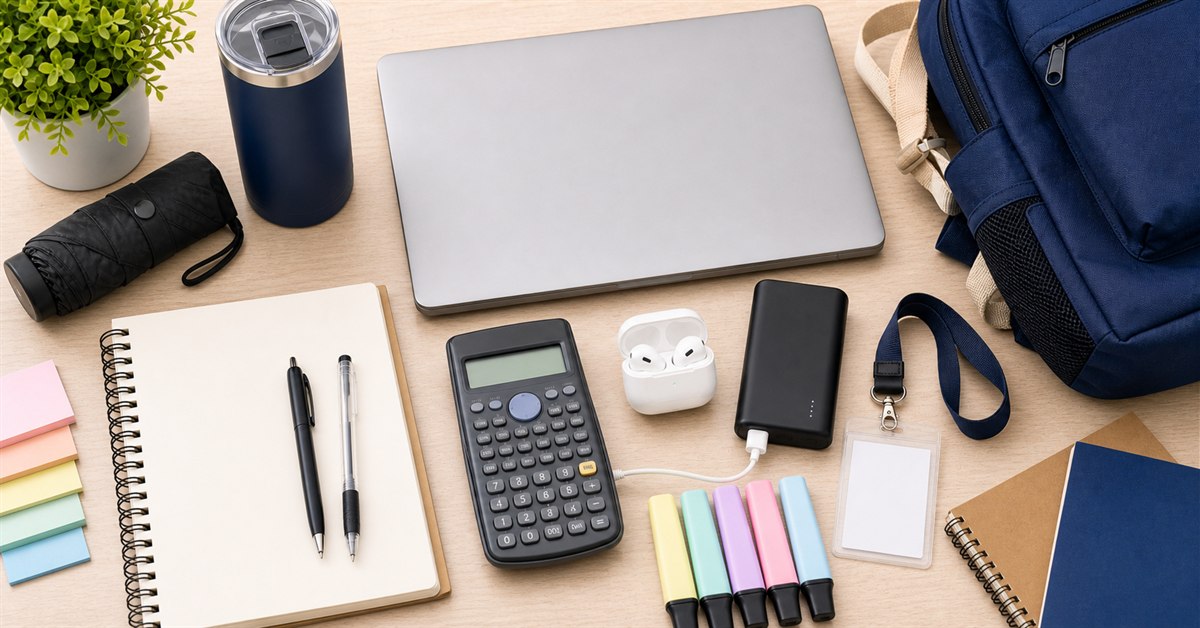
What every Filipino college student needs in 2026 is a setup that survives real campus life: long commutes, rainy afternoons, packed schedules, online submissions, group chats, AI-assisted studying, and sudden "bring this tomorrow" requirements. The practical starter kit is simple: laptop or tablet access, a good backpack, a power bank, reliable chargers and cables, earbuds or headset, course-required calculator, stationery, rain gear, tumbler, and a small health or dorm kit.
This guide pulls together the more specific buying guides we already built: best student backpacks Philippines 2026, best laptops Philippines under ₱20,000, best power banks Philippines 2026, best true wireless earbuds under ₱2,000, best calculators Philippines for students 2026, best pens under ₱100, best highlighters Philippines 2026, and best notebooks and pads Philippines 2026.
Our top picks
- MOST IMPORTANT TECHLaptop or tablet setup₱8,000-₱35,000+Check price
- BEST DAILY CARRYStudent backpack with laptop sleeve₱800-₱4,500Check price
- COMMUTE RESCUE20000mAh power bank₱800-₱2,500Check price
- STUDY AUDIOWireless earbuds or wired headset₱500-₱2,000Check price
- RAINY-SEASON BASICUmbrella + waterproof pouch₱300-₱1,200Check price
Quick checklist: Filipino college student essentials
| Essential | Why it matters | Starter budget |
|---|---|---|
| Laptop or tablet access | Docs, LMS, research, presentations, AI-assisted study | ₱8,000-₱35,000+ |
| Backpack with laptop sleeve | Carries tech, notebooks, water, rain gear | ₱800-₱4,500 |
| 20000mAh power bank | Keeps phone alive during commute and long campus days | ₱800-₱2,500 |
| USB-C charger and cable kit | Prevents charging bottlenecks | ₱300-₱1,500 |
| Earbuds or wired headset | Online class, commute review, calls | ₱300-₱2,000 |
| Calculator if course requires it | Math, science, engineering, accounting, finance | ₱350-₱2,600 |
| Notebook, pens, highlighters | Still needed for notes, quizzes, and review | ₱300-₱1,500 |
| Umbrella and waterproof pouch | Rain, heat, commute protection | ₱300-₱1,200 |
| Tumbler and lunch kit | Saves money on drinks and snacks | ₱300-₱1,500 |
| Dorm or long-day kit | Lamp, fan, extension cord, hygiene pouch | ₱500-₱3,000 |
Do not buy everything at once if the budget is tight. Buy the non-negotiables first, attend the first week, then upgrade based on real class requirements.
What to buy first
The best order is:
- Required school items: ID holder, notebooks, pens, calculator, lab or course items.
- Daily carry: backpack, umbrella, water bottle, small pouch.
- Tech reliability: charger, power bank, storage, earbuds or headset.
- Study comfort: laptop stand, desk lamp, external keyboard, fan.
- Nice-to-have items: premium stationery, aesthetic organizers, extra bags, decor.
AI tools are now part of how many students brainstorm, summarize, code, draft, and review. But AI does not replace the basics. If your phone dies, your charger breaks, your bag gets soaked, or your laptop cannot run a browser and document editor smoothly, no AI app will fix the day.
College essentials for Filipino students
Laptop or tablet setup
Our verdict: The most important digital tool for documents, LMS work, presentations, research, coding, design, and AI-assisted study.
Every Filipino college student needs reliable computer access, even if they do not own a laptop on day one. A phone can handle group chats and quick PDFs, but it is frustrating for long documents, spreadsheets, presentations, coding, research, and online submissions.
If the student has a tight budget, a used business laptop or budget laptop can be enough for documents, browser work, and video calls. Creative, engineering, architecture, IT, and data-heavy courses need stronger specs. A tablet is useful for reading and handwritten notes, but it is not always a full laptop replacement.
For AI-assisted studying, prioritize a machine that can run multiple browser tabs, documents, video calls, and cloud tools without freezing. The best AI setup is still a stable laptop, reliable internet, organized files, and responsible study habits.
What we like
- Needed for documents and LMS work
- Useful for AI-assisted studying
- Better than phone-only research
- Essential for many college courses
- Can last several years if chosen well
- Supports internships and job applications
Watch out for
- Biggest expense in the kit
- Specs depend heavily on course
- Cheap laptops can age quickly
- Needs charger and bag protection
- Used units require careful checking
Student backpack with laptop sleeve
Our verdict: The daily carry essential that protects the laptop, keeps supplies organized, and makes commute-heavy college life easier.
A college backpack should be more than a cute bag. It needs a padded laptop sleeve, comfortable straps, enough space for notebooks, a water-bottle pocket, and at least one quick-access pocket for ID, wallet, keys, or earbuds.
For commuters, water resistance matters. No ordinary school bag is truly typhoon-proof, so add a rain cover or use a waterproof pouch for electronics. If the student rides jeepneys, buses, trains, or tricycles, avoid bags with weak zippers and thin straps.
Do not overbuy size. A 25L to 30L bag is enough for most college students. Bigger bags encourage carrying too much.
What we like
- Protects laptop and notebooks
- Keeps daily items organized
- Important for commuters
- Can last multiple school years
- Useful for internships and travel
- Pairs with rain cover for wet season
Watch out for
- Cheap bags can fail quickly
- Premium brands cost more
- Too-large bags get overpacked
- Water resistance is not waterproofing
- Needs regular cleaning
20000mAh power bank
Our verdict: The practical rescue item for long commute days, group work, mobile data, maps, e-wallets, and emergency contact.
A power bank is not just for TikTok and music. For Filipino college students, the phone is the class group chat, map, e-wallet, authenticator, camera scanner, document viewer, hotspot, and emergency contact device.
A 10000mAh power bank is lighter. A 20000mAh power bank is better for long campus days, commute-heavy schedules, brownouts, and students who use mobile data heavily. USB-C input and output are worth paying for because many newer phones, tablets, and earbuds use USB-C.
Buy from known brands or trusted stores. Ultra-cheap high-capacity claims are a red flag.
What we like
- Keeps phone alive during commute
- Useful for mobile data and maps
- Helps during brownouts
- Can charge earbuds and small devices
- Important for e-wallet and emergency access
- USB-C models are more future-friendly
Watch out for
- Heavy at 20000mAh
- Cheap fake capacity is common
- Needs charging discipline
- Can be restricted in checked luggage when flying
- Fast charging depends on phone and cable
USB-C charger, cable, and adapter kit
Our verdict: The boring kit that prevents the most common tech failure: having the device but not the right cable or charger.
Every college bag should have a simple charging pouch: one reliable wall charger, one USB-C cable, one backup cable for the student's actual phone, and a small adapter if needed. If the student uses a USB-C laptop, a higher-wattage charger may reduce how many bricks they carry.
Do not buy mystery chargers just because they are cheap. Poor chargers and cables can charge slowly, disconnect easily, or heat up. A decent cable with proper strain relief is worth more than five weak cables that fail mid-semester.
For dorms, add a safe extension cord or power strip. Avoid overloaded generic strips, especially with laptop chargers, fans, lamps, and phone chargers plugged in together.
What we like
- Prevents daily charging problems
- Works across phone, earbuds, power bank, and tablet
- Easy to keep in a pouch
- USB-C is increasingly useful
- Good cables last longer
- Useful for dorm and commute
Watch out for
- Cheap chargers can be unsafe
- Fast charging needs compatible devices
- Laptop USB-C charging needs higher wattage
- Cables still get lost
- Power strips need safety checks
Wireless earbuds or wired headset
Our verdict: Useful for online classes, commute review, recorded lectures, library videos, and calls.
Wireless earbuds are useful for commuters and students who watch lectures on a phone or laptop. They are convenient for recorded classes, review videos, voice notes, and calls.
Still, a cheap wired headset with mic is a smart backup. Wired audio does not need charging, has fewer pairing problems, and can be more reliable for online class recitations or interviews.
If the student studies in noisy spaces, prioritize call microphone quality and comfortable fit before brand hype. Noise cancellation helps, but it is not magic inside loud jeepneys or cafeterias.
What we like
- Useful for online class and review videos
- Portable for commutes
- Good for calls and voice notes
- Budget options are strong now
- Wired backup is cheap
- Helps in shared rooms
Watch out for
- Wireless earbuds need charging
- Small cases get lost
- Mic quality varies
- Noise cancellation costs more
- Bluetooth issues happen on older laptops
Scientific or financial calculator
Our verdict: Essential for math, science, engineering, accounting, finance, and board-review tracks, but the exact model should follow course rules.
Not every college student needs a calculator, but the students who need one usually need the correct type. STEM students may need a scientific calculator. Accounting students may prefer a desk calculator for repeated arithmetic. Finance students may need a financial calculator if the instructor allows it.
The critical rule is exactness. For board exams, do not buy based on popularity alone. Check the current PRC or school list and match the exact printed model number, casing requirement, and allowed function type.
If the student is a freshman and the course is not yet clear, wait for the syllabus before buying an expensive model.
What we like
- Required for many STEM and business courses
- Physical calculator is faster than phone apps in class
- Can last years
- Specific models help with teacher examples
- Important for board-review planning
- Good resale value if cared for
Watch out for
- Wrong model can be wasted money
- Exam rules can be strict
- Counterfeits exist
- Premium calculators are expensive
- Some courses do not need one
Notebook, pens, and highlighter kit
Our verdict: Still necessary for handwritten notes, quizzes, formulas, diagrams, review summaries, and classes where laptops are not practical.
Even in 2026, college students still need paper. Handwritten notes help in math-heavy classes, lab work, review summaries, diagrams, and classes where laptops are distracting or not allowed.
Start with two good notebooks, one yellow pad or legal pad if required, two black pens, two blue pens, one red pen, one pencil, and three to five highlighter colors. Add index cards, sticky tabs, and binder clips only if the subject actually uses them.
Avoid overbuying stationery before classes start. Aesthetic setups look good online, but real college bags get heavy fast.
What we like
- Cheap and useful
- Works without battery
- Good for formulas and diagrams
- Better for quick quizzes and lab notes
- Easy to customize by subject
- Pairs with highlighters and sticky tabs
Watch out for
- Easy to overbuy
- Heavy if you carry too many notebooks
- Cheap paper can bleed
- Loose papers get messy
- Needs a system to stay organized
Umbrella, rain cover, and waterproof pouch
Our verdict: The Philippine campus commute kit for sudden rain, harsh sun, wet bags, and electronics protection.
An umbrella is a college essential in the Philippines because it handles both rain and sun. Choose a compact umbrella that actually fits the backpack, not a huge one that gets left at home.
For laptop users, add a rain cover or waterproof pouch. Even a water-resistant backpack can let water through during heavy rain, side splash, or long wet commutes. Keep chargers, power bank, IDs, and documents in a pouch instead of loose at the bottom of the bag.
This is one of the cheapest ways to avoid expensive damage.
What we like
- Handles rain and sun
- Protects electronics and documents
- Cheap compared with laptop repair
- Useful all year
- Compact options fit bags
- Good for commuters
Watch out for
- Umbrellas get lost easily
- Cheap umbrellas break in wind
- Rain covers need correct bag size
- Waterproof pouches add bag clutter
- Still not full flood protection
Tumbler, lunch box, and snack kit
Our verdict: The daily cost-control kit for students who spend too much on drinks, snacks, and emergency food.
A tumbler and small food container can save real money across a semester. Even if the student still buys meals, bringing water and one snack reduces impulse spending during long breaks.
Choose a tumbler that fits the bag side pocket and is easy to clean. Huge bottles are useful at home but annoying if they make the bag heavy. For lunch boxes, prioritize leak resistance and simple shapes over complicated compartments that are hard to wash.
This is not about being strict. It is about having a fallback when class runs late or food lines are long.
What we like
- Reduces daily drink spending
- Useful for long campus days
- Keeps water available during commute
- Simple baon backup
- Good for health and budget
- Pairs with insulated lunch bag if needed
Watch out for
- Adds weight to the bag
- Cheap bottles can leak
- Needs daily washing
- Large tumblers may not fit side pockets
- Lunch boxes need food planning
Desk lamp, small fan, extension cord, and hygiene pouch
Our verdict: The comfort and safety kit for dorm students, boarding-house students, and anyone with long campus days.
Dorm and boarding-house students need a different kit from commuters. A desk lamp, small fan if allowed, safe extension cord, laundry bag, bath kit, slippers, hangers, and small storage bins make daily life easier.
For long campus days, a hygiene pouch matters even if the student lives at home. Keep alcohol, tissue, wipes, small medicine, bandages, sanitary items if needed, and a spare mask if the campus or clinic requires it.
Do not overload extension cords. Buy safe, known-brand power strips and unplug chargers when not in use.
What we like
- Improves long study sessions
- Useful for dorms and boarding houses
- Keeps hygiene items ready
- Desk lamp helps evening work
- Small fan helps hot rooms
- Extension cord solves limited outlets
Watch out for
- Dorm rules may restrict appliances
- Cheap extension cords can be unsafe
- Adds clutter if overbought
- Fans and lamps need charging or outlets
- Storage depends on room size
Budget tiers
Use these as realistic starting points:
| Budget | What to prioritize |
|---|---|
| ₱1,000-₱2,000 | stationery kit, umbrella, tumbler, ID holder, hygiene pouch |
| ₱3,000-₱5,000 | add better backpack, power bank, charger kit |
| ₱6,000-₱10,000 | add earbuds, calculator, better rain protection, dorm basics |
| ₱18,000+ | budget laptop or used business laptop |
| ₱30,000+ | stronger laptop for heavier college workloads |
If parents or relatives are buying gifts, ask for the boring essentials first: backpack, power bank, charger, calculator, or laptop fund. These get used more than decorative desk items.
What to avoid
Avoid buying a full aesthetic stationery haul before seeing the syllabus. Avoid cheap power banks with fake capacity claims. Avoid backpacks with no laptop padding if the student carries a laptop. Avoid relying on phone-only work for document-heavy courses. Avoid buying a calculator without checking the exact course or exam requirement. Avoid overloaded extension cords in dorms.
The best college kit is not the biggest kit. It is the one the student actually carries, charges, cleans, and uses.
Source and price notes
Prices and availability were checked on May 29, 2026 using the site's current product guides, Philippine retailer visibility, and Shopee/Lazada category searches. Prices move during back-to-school season, payday campaigns, imported-stock changes, and campus-opening demand, so treat the ranges above as practical buying bands rather than fixed prices.
Key supporting sources and guides include National Book Store, SM Stationery, best student backpacks Philippines 2026, best laptops Philippines under ₱20,000, best power banks Philippines 2026, best true wireless earbuds under ₱2,000, best calculators Philippines for students 2026, best highlighters Philippines 2026, best pens under ₱100, best notebooks and pads Philippines 2026, and best umbrellas Philippines rainy season.
FAQ
What does every Filipino college student need in 2026?
Every Filipino college student needs reliable computer access, a good bag, phone charger, power bank, notebooks, pens, highlighters, course-required calculator, water bottle, umbrella, ID holder, and a small hygiene pouch. Dorm students should add room and laundry basics.
Does every college student need a laptop?
Every student needs reliable computer access, but not every student needs to buy a laptop immediately. If the course is document-heavy, tech-heavy, design-heavy, or online-submission-heavy, owning a laptop becomes much more important.
What should college freshmen buy first?
Buy required course items first, then daily carry and tech reliability. Start with a backpack, notebooks, pens, calculator if required, phone charger, power bank, umbrella, and ID holder. Upgrade earbuds, desk setup, and premium stationery later.
How much should college essentials cost in the Philippines?
Without a laptop, a practical starter kit can land around ₱3,000 to ₱8,000 depending on bag, power bank, earbuds, calculator, and rain gear choices. With a laptop, add roughly ₱18,000 to ₱35,000 or more depending on course requirements.
What is the most important commuter essential?
A power bank and compact umbrella are the most important commuter essentials. Add a waterproof pouch for electronics, a tumbler for water, and wired earphones or earbuds for review videos and calls.
What do dorm students need?
Dorm students need a desk lamp, safe extension cord, laundry bag, hangers, bath kit, slippers, small fan if allowed, storage bins, tumbler, food containers, and a hygiene or medicine pouch. Check dorm rules before buying appliances.
Are AI tools necessary for college?
AI tools can help with brainstorming, summaries, coding practice, research organization, and language checks, but they do not replace understanding or citations. A reliable laptop, internet access, organized files, and responsible study habits matter first.
What should students avoid buying too early?
Avoid overbuying notebooks, highlighters, desk organizers, expensive calculators, dorm appliances, and aesthetic accessories before the syllabus and class routine are clear. Buy lean, then upgrade after two weeks of actual use.
Final verdict
For most Filipino college students in 2026, the essentials are not complicated: computer access, backpack, power bank, charger kit, earbuds or headset, course-required calculator, stationery, rain protection, tumbler, and a small dorm or hygiene kit. Buy for the student's real commute, course, budget, and campus routine, not for the prettiest desk photo.